
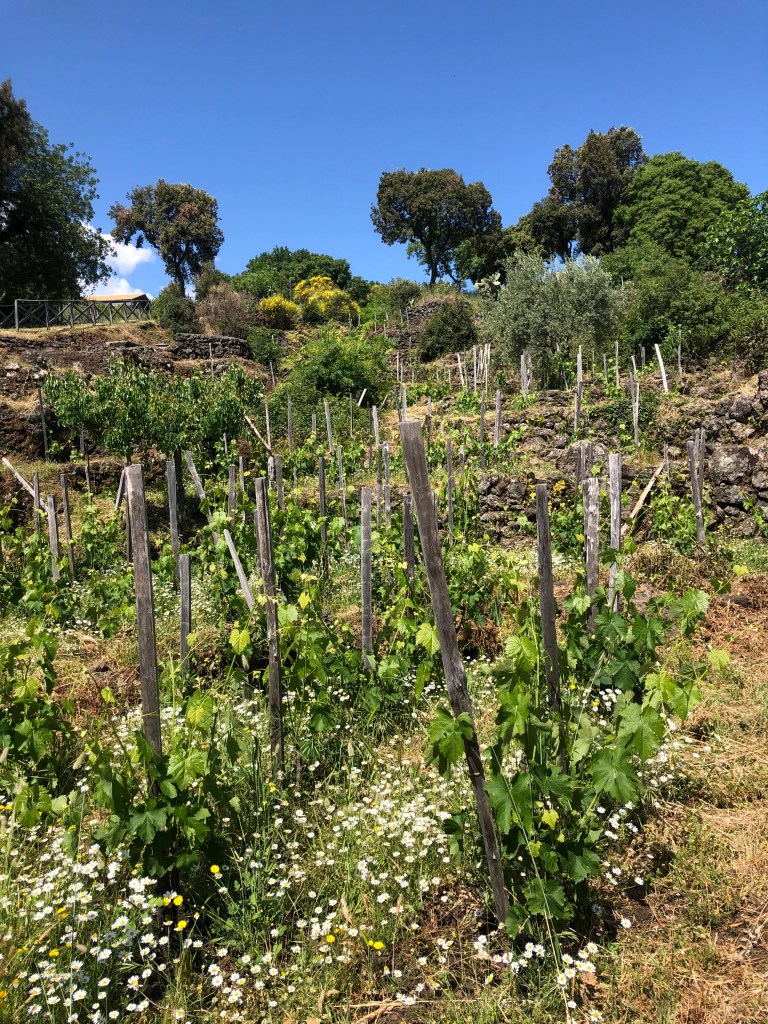
On a recent trip to the Etna region of Sicily, the accommodation for my husband and I was in the cottage of a vineyard owner. In viewing the pictures on the Agriturismo website, it seemed to appeal to our seeing-what-local-life-is-like preferences when we travel. The almost impassable driveway was well worth it as we found that the pictures could not do the setting justice, finding ourselves perched above terraced grape vines overlooking the Aegean Sea and in the shadow of an awakening Mt. Etna.
We then met the vineyard owner, our host, for a vineyard tour and wine tasting event. The grape vine terraces near the cottage were only one of his plots. Another larger one was where the tour took place. It was here that our scruffy Sicilian host morphed into a savant as his passion for his vineyard, the environment around his plants and the wine they produce became evident.
“She is about a hundred years old and she still produces beautifully”, he remarked as he introduced us to one of his beloved vines.
Procuring this vineyard required time, expense and diplomacy on the part of our host. Its cultivation had long ago been abandoned by the four descendents of the original owner, who had no interest in continuing its production. Our host described how he approached each family member and over time was able to negotiate the purchase of the entire property. That is when his work began to restore these ancient vines to fruitfulness. How did he do this?
Around the base of each vine, the soil was pushed back to form a bowl. This was done between October and May to capture as much precipitation as possible and direct it toward the roots. At the end of May, the bowls would be filled in with soil to retain the moisture that had been gathered from evaporating under the searing summer sun. He used no irrigation and instead depended on the rain to be sufficient. To strengthen and deepen the root system, he would till around each vine, removing the weeds but also removing the shallow roots. He did not want the vine to depend upon a shallow root system and by removing them, forced the deeper roots to draw from a more stable moisture supply. “I mustn’t spoil them by offering water. Then their root system will not be strong enough to take them through the long, hot summer.” he explained.
We walked through terrace after terrace, descending through his vineyard interlaced with fruit trees, olive trees, herbs and flowers. “I want to preserve the biodiversity of this land because all of the plants and the insects and animals, they are interdependent.”
He talked about the plants, the land, the harvest, the process of converting grapes into wine, very fine wine. He even spoke about sleeping in the vineyard as the grapes neared readiness for harvest. “I stay here to protect the harvest since I have had thieves come in to steal my grapes!”
Hearing this vineyard owner’s passion and seeing the work of his hands, it became clear that this was not our host’s hobby, it was not his business, it was his love. He loves his vines. He is a vinedresser. I was walking alongside and talking to a living depiction of John 15 and Isaiah 5.
Later during our stay at his cottage, we saw him working alone among the vines on the property. We joined him to see what needed tending. It was the time of year to tie up the developing branches lest they be damaged by the wind at this tender and vulnerable stage of their growth. Stooping low with his arms outstretched, he would gently lift and and gather the branches that already had tiny grapes beginning to develop and with a natural twine loosely tie them up to a central post. He would also inspect the branches and those that were fruitless and growing below the former pruning cuts, he would remove along with excess foliage. “These are suckers and even though they appear to be leafy and healthy, they will drain the energy of the plant away from the developing fruit.” And so we walked from plant to plant, inspecting each one, carefully securing the delicate but fruitful branches and removing those that would divert the plant’s resources. Each plant had to be individually assessed, uniquely pruned, delicately tied.
After an afternoon of successful work and timely tending, it was an occasion to celebrate. The vinedresser gathered his guests and workers (on our patio, with our wine) to celebrate the day’s work, to relax in the beauty of the natural surroundings and to enjoy each other’s company. He also generously recompensed us for our availability to host his celebration 🙂
In learning from, walking with and working alongside an actual vineyard owner who knows and cares for his vines, I could only imagine how much more the Father cares for His vineyard of living souls.
During our stay and upon our return, I compared the imagery of vines and vineyard owners in scripture with what I had seen and experienced in Sicily. This has led me to write about each of the main characters: the vineyard owner, the vine, the branches and the fruit. I hope that these insights will propel your own study, to see if these things are so.
Who do you think each of these characters represents in the allegory of the vine and vineyard?
Are there any elements in the description above of our experiences in Sicily that shed more light on what the writers of scripture might have intended their readers to understand about the character of God and our relationship with Him?
If you read the posts about each of the characters in the vineyard allegory (I hope that you will) my hope is that God will reveal His desire to be as intimately related to you as the branches are to the vine.
 An Open Door