
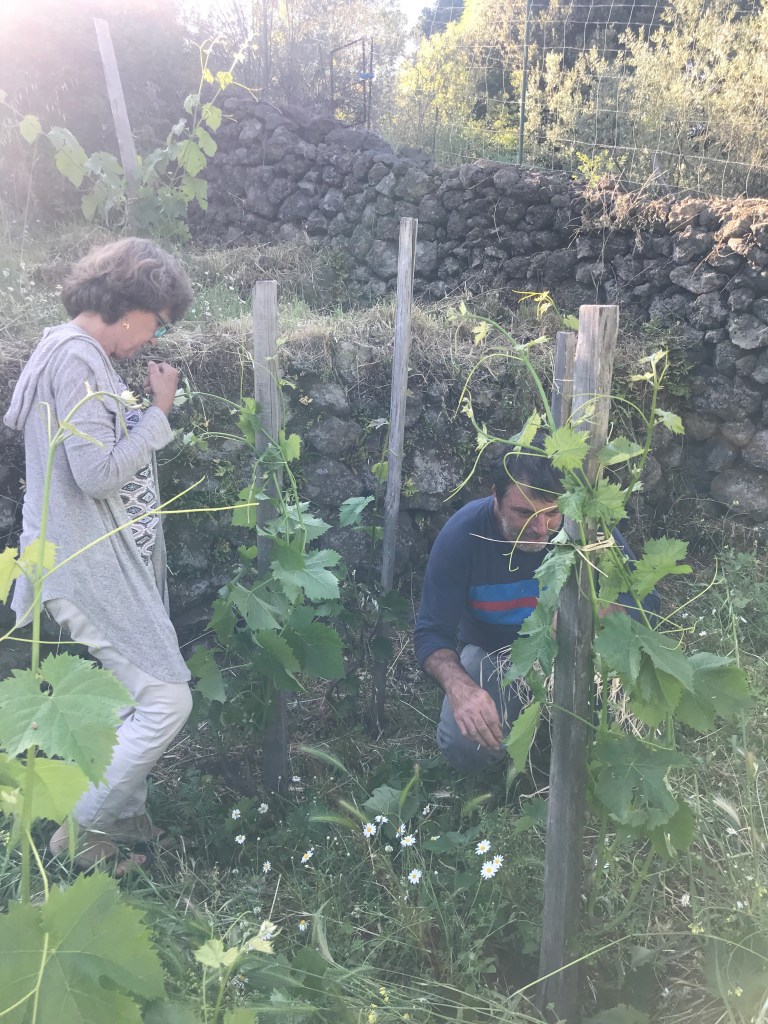
Our scruffy Sicilian host did not initially reflect our preconceived images of the keeper of the Biblical vineyard. Where the resemblance began to take shape was as he walked among his beloved vines. He addressed them by name, not that each vine had a name, but he spoke of them as “she”. “ She is growing so well. Look at how beautiful she is. She is a hundred years old and she is still producing fine grapes.” The love that this man had not only for his vineyard, but also for the individual vines, was stunning.
His love not only motivated him to care for them, his love cost him dearly to procure them. He described how the care for this old vineyard had been forsaken by the previous owners. Four children had inherited four quadrants of the property from their forefathers who had planted the vineyard and tended it. The children, having no interest in the constancy of work required to keep the vineyard productive, had left it untended for decades. Our host described the years of negotiation and cost to approach each owner and convince them to sell their portion of the property. He would not settle or be satisfied until he had procured the entirety of the original vineyard.
Our heavenly vinedresser has also gone to exorbitant ends to procure for Himself the entire vineyard, even in its untended, overgrown, unproductive state. From the four quadrants of the earth, he is gathering a people for Himself, from every tribe, tongue, people and nation. But it came at an exorbitant cost, His one and only Son.
Revelation 5:9 states,” And they sang a new song saying,
‘Worthy are You to take the scroll and break open its seals;
For You were slaughtered and You purchased people for God
with Your blood from every tribe, language, people and nation.’”
Once the vineyard belonged to our host, he went to work to restore it to become fruitful once again. He first cleared the stones that had thrust up out of the ground. He walked us past an enormous pile of volcanic rocks that had to be extracted as they interfered with the growth of his vines. He cleared stones, he removed the overgrowth of weeds and briers that were suffocating the plants, he pruned off the overgrown, unproductive branches that had been left on the vines for years, diverting the energy of the plants from bearing fruit. He optimized the soil around the plants to receive nutrients and receive the supply of seasonal rain. He tilled around the base of each vine, cutting off the superficial roots so that the plant’s roots would grow deep and access the more constant supply of water that resided well below the surface. He repaired the fencing around the property to prevent animals from coming in and ruining his crop. However, even as he described the enormous amount of work that went into restoring his vineyard, he did not describe it as a labor of drudgery, but he described it as what was necessary to see this vineyard fulfill its original purpose, the production of excellent grapes.
For our host, tending his vineyard was clearly a labor of joy and love. This resurrected vineyard is truly his delight and the vines are his individually known and cared for children!
Our encounter with a human vinedresser gave me a glimpse into the heart of our heavenly vinedresser, our Father. Isaiah captures this sentiment in his love songs of chapters 5 and 27. This theme is also echoed by Jesus when he took his disciples through a vineyard on his way to Gethsemane. Hear in these passages the passion of the vinedresser:
“Let me sing for my beloved my love song concerning his vineyard:
My beloved had a vineyard on a very fertile hill.
He dug it and cleared it of stones and planted it with choice vines;
He built a watch tower in the midst of it and hewed out a vat in it;
And he looked for it to yield grapes…” (Isa.5:1-2)
“A pleasant vineyard, sing of it!
I, the Lord, am its keeper:
Every moment I water it, lest anyone punish it.
I keep it night and day.” (Isa.27:3)
“I am the true vine and my Father is the vinedresser.
As the Father has loved me, so I have loved you. Abide in my love. (Jn.15:1,9)
While I don’t want to overstretch the analogy of our human vineyard owner to our Father, the vinedresser, I couldn’t help but draw spiritual lessons from some of what I observed. Not only did our host take pains and cost to procure this vineyard, and not only does he love his vineyard, but in order to make it productive, he prunes the vines and tills the soil. Tilling had many purposes. It loosens the compacted ground so that water could penetrate more readily and it creates air pockets so that the roots could breathe. I could see the parallels to principles of growth as Christ-followers in these two benefits of tilling. But it was tilling to remove the superficial roots that most caught my attention.
Sicily has a wonderfully difficult climate for growing grapes. This vineyard on the slope of Mt. Etna receives rainfall and snow melt in winter and spring, but the summers are very hot and dry. If the vines are watered continually from above, their root systems will become superficial and will not be able to sustain the plant during the long, hot dry season. By cutting off the top roots as the dry season approaches, the vines are forced to send their roots downward into the aquifer below. The vinedresser not only prunes what grows above the ground, he also prunes what lies beneath the surface. It seems harsh, but it is for the vine’s ultimate good.
Shallow roots do not sustain a vine. Shallow faith cannot sustain us either. The loving vinedresser may need to force our roots to go deep, deep into his word, deep into knowing His unchanging character, deep into trusting His word and character when things on the surface get “tilled”, broken up, upset, chopped. The consequences of not doing this are dire. Jesus describes this in his explanation of the parable of the soils in Matthew 13.
“Other seeds fell on rocky ground, where they did not have much soil, and immediately
they sprang up, since they had no depth of soil. But when the sun rose, they were
scorched. And since they had no [deep] root, they withered away.
As for what was sown on rocky ground, this is the one who hears the word
and immediately receives it with joy, yet has no root in himself but endures for a while.
And when tribulation or persecution arises on account of the word, immediately he falls
away.” (Mt.13:5,6,20,21)
The vinedresser both removes the stones and cuts the top roots so that what is pictured above does not come to pass. The application in my own life is immediate as I think back on those difficult times, deep disappointments and losses as events and seasons that over time deepened my faith in and love for Him. Were it not for those struggles, I would not know the Lord, I would not lean into Him and trust Him like I do today.
The picture of the growth that such tilling produces is described by Jeremiah as he contrasts the desert shrub (whose root system is superficial, like the tumbleweed) to the tree.
“Blessed is the one who trusts in the Lord, whose trust is the Lord.
He is like a tree planted by water that sends out its roots by the stream,
and does not fear when heat comes, for its leaves remain green,
and is not anxious in the year of drought,
for it does not cease to bear fruit.” (Jer.17:7-8)
Another time that we shared with our vinedresser host occurred on the final day of our stay. It was late in the day as we were driving in to town for a few groceries, when we noticed our friend, alone, in his vineyard moving from plant to plant, stooping over each one, gathering in his outstretched arms the drooping branches and gently tying them up to a central stake. We abandoned our trip to town to join him in the vineyard. Over the next several hours, he instructed us in this critical stage of tending the rapidly growing plants. Each vine had numerous tender, leafy branches that had grown out of the woody vine. As they grew longer, gravity would pull many of these tender shoots downward. Our host shared that the branches were especially vulnerable at this stage of their young growth. A strong wind or heavy rain could easily break off the immature branches unless they were lifted up and secured. Around his waist he had a sack of natural twine. He would stoop low next to each vine, stretch out his big arms to gather the verdant and vulnerable branches and then as he held them in place, he would gently tie them to the central stake. We became his apprentices. “Don’t tie them too tightly. Just enough to hold them up.” But as he was tying up the branches, he was also inspecting them to see which ones had tiny clusters of immature grapes, which branches were suckers and which branches needed their leaves thinned so that the sun could fall on the developing grapes to ripen them. He pruned as he went and he pruned each vine uniquely. For each vine he considered both the overall health of the plant and the production of fruit.
I have reflected so many times on the image of our burly vinedresser friend with outstretched arms stooping low to tenderly gather up the weak leafy branches in his strong arms and then gently holding them as he formed a loose knot with the twine so that they would be protected.
John 15:2 tells us about this function of the vinedresser. “Every branch in Me that bears no fruit, He takes away and every branch that does bear fruit, He prunes that it may bear more fruit.” The common words that Bible translators use for the Greek word aero are take away. Other translators however use an alternate definition of this word aero: to raise up, lift up, prop up. The Passion translation uses this definition in John 15:2;
“He cares for the branches connected to me by lifting and propping up the fruitless branches and pruning every fruitful branch to yield a greater harvest.” (TPT)
This is what I saw. I saw the human vinedresser examining the branches, inspecting them to see that they are properly connected to the vine, and if properly connected but misoriented, growing downward instead of upward, gently lifting and securing them so that they might become fruitful.( For a deeper discussion on this see the article John15:2 “Lift Up” by Paul Bucknell at bffbible.org.)
Have you ever lost your orientation? I certainly have – looking downward at my circumstances, growing in a worldly direction, downtrodden by a deluge of difficulties, looking for fruit and fulfillment in the wrong places, with wrong expectations. Certainly when Jesus spoke these words to his disciples, it was just before they would all abandon him, deny him and hide in fear. They were definitely disoriented branches who showed little evidence of fruit. But Jesus did not cut them off. Rather the resurrected Christ came to them, spoke peace to them, stretched out his arms to show them his scars and wounds and lifted them back to their proper orientation toward himself.
“All that the Father gives to me will come to me; and the one who comes to me I will most certainly not cast out.” Jn.6:37
Well the last experience that we shared with our vineyard owner friend was after we had spent hours with him, pruning and tying up branches. We had used up all his twine and the sun was setting. With a satisfied sigh, he gazed at his vines. “They look very good”. And then turning toward us he said, “We must celebrate our work together!”
With that we climbed the hill to our cottage. He invited other guests and workers to join in the celebration on our patio. We opened the wine that his vineyard had produced years prior and celebrated a well tended vineyard accompanied by a pyroclastic display from the top of the looming Mt. Etna.
Our God is a celebratory God!
On this mountain the Lord of hosts will make for all peoples a feast of rich food,
a feast of well-aged wine, of rich food full of marrow, of aged wine well refined. Isa.25:6
Blessed are those servants whom the master finds awake when he comes. Truly I say to you, he will dress himself for service and have them recline at table, and he will come and serve them. Lk.12:37
But the father said to his servants, “Bring quickly the best robe, and put it on him, and put a ring on his hand and shoes on his feet. And bring the fattened calf and kill it, and let us eat and celebrate… It was fitting to celebrate and be glad, for this your brother was dead and is alive; he was lost and is found. Lk.15:22,23,32
Let us rejoice and exult and give him glory, for the marriage of the Lamb has come and his Bride has made herself ready; it was granted her to clothe herself with fine linen, bright and pure – for the fine linen is the righteous deeds of the saints. And the angel said to me, “Write this: Blessed are those who are invited to the marriage supper of the Lamb.” And he said to me,”These are the true words of God.” Rev.19:7-9
How much more in all aspects is our Father God, the keeper and nurturer of his vineyard of souls. He purchases us and works on our behalf because he loves us. He tends us each uniquely, he lifts us up and tethers us to himself, he prunes us both above and below so that we might be strong and fruitful in Him. And he then celebrates in anticipation of the fruit that will be borne from our lives, which is our deepest joy and for his great glory. Finally, He invites us into the greatest celebration that the universe has ever known, all because of his own costly work of sacrificial love and mercy to redeem and restore an untended people.
What do you see in this reflection?
A new picture of our Father, the heavenly vinedresser, who lovingly works in his vineyard of souls?
A new recognition of the work that He might be doing in your life so that you would be deeply rooted and fruitful?
A glimpse of his tenderness toward misdirected growth and his outstretched arms to gather you up?
A celebration in anticipation of the harvest of delicious fruit from your life?
Other vines that He longs to purchase and restore to Himself?
 An Open Door