
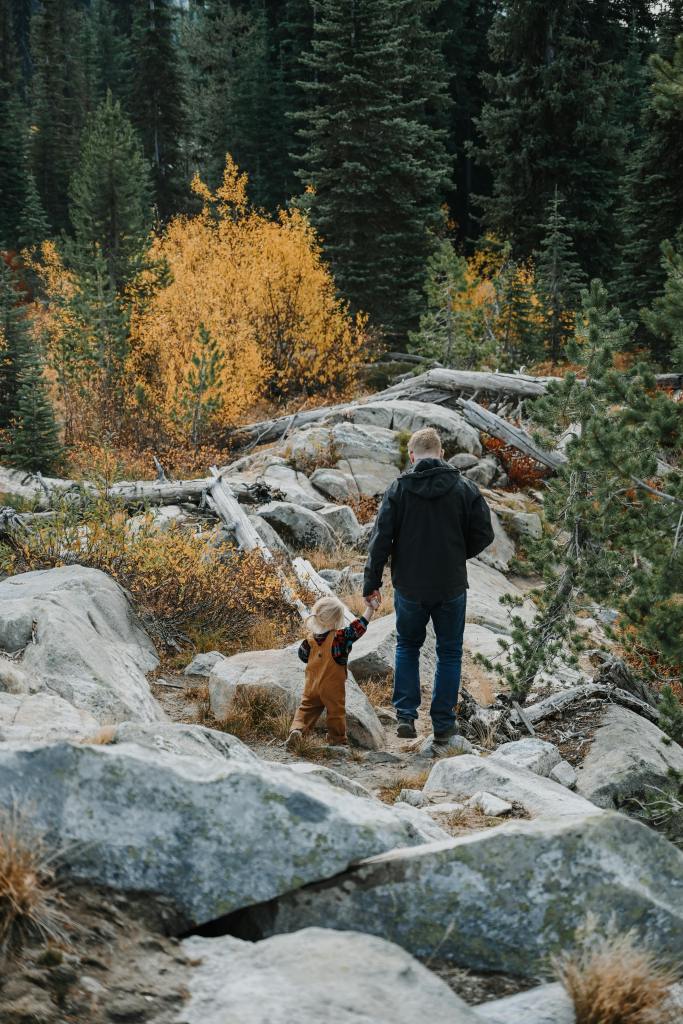
One of the advantages of living in New England is abundant access to hiking trails. Whether it is in the White Mountains of New Hampshire, the Green Mountains of Vermont, the Berkshires of Massachusetts or along random hills, lakes or streams, every town has its network of trails. There are those trails that are my regular go to’s that I have traversed countless times. These are so familiar that there is no need to look for trail markers since every turn is familiar territory. However it is always a treat to explore a new set of trails.
We recently went with our daughter and her children up the Rattlesnake Ridge trail in New Hampshire. It is a wide and well traveled trail which makes it easy to follow except when coming down off the ridge. There the trail is less obvious as it traverses across rock slabs and plunges into dense woods. We traveled on what we thought was the trail, until it became increasingly narrow and difficult to follow, which caused us to pause. Could this still be the trail?
There are two responses to this scenario. One is to keep going in hope of finding the trail, the other is to double back to find out where we might have lost the trail. In this case, with two little ones in tow, the only solution was for Papa to go back to find a trail marker and see how we might have diverged. Sure enough, we hadn’t taken a sharp left when coming off the rock slabs and instead had plunged ahead on what appeared to be a trail, but without any confirming markers. If we hadn’t had children with us, we might have been tempted to forge ahead because after all, who wants to go backwards? All of us at one time or other have chosen to keep going in hopes of reconnecting with the trail and even thinking that we may have found a shortcut, the romanticized road less traveled. Sometimes it works out. Other times I have become more and more hopelessly lost. In New England, where most of our hiking is in the midst of trees, it is rare to be able to see ahead to get one’s bearings. But New Englanders, who are known for their stubborn, can-do spirit, can find turning back unappealing.
What is it about human nature that resists doubling back and admitting that we have lost the trail? Why is it that we will keep walking, keep driving, keep living without doubling back to a place where our journey was clear? Even when we get the feeling that this can’t be right, we reason that maybe if I just keep going a little further down the trail, if I drive a little longer, if I pursue this life trajectory a little more intently, I will reach my desired destination. Or perhaps we are so deep in the woods, so directionally convoluted, so far immersed in life choices, that we have no idea how to backtrack even if we wanted to. We are lost!
The same experience may be true for us spiritually. We may feel that we have lost our way and that there is no way to return to a point in time when life with God was simple and clear. Or perhaps there never was such a time for you. Perhaps you have traveled many spiritual pathways or none at all and yet you find yourself disappointed with where your journey has brought you thus far. Should you just tuck your head down and keep going? Or is this a time to stop and consider? The prophet Jeremiah wrote to the people of Judah, warning them that the path that they were taking was leading them away from security and peace with God.
Thus says the Lord:
Stand by the roads and look,
And ask for the ancient paths, where the good way is;
And walk in it, and find rest for your souls. Jer.6:16
Judah scoffed at these words of the Lord through Jeremiah. The verse above finishes with their reply; “We will not walk in it.” Though the entirety of this chapter is filled with warnings of continuing on the path they were taking, they refused to double back to the “ancient path” wherein there is rest for their souls.
What about you?
Are you at a crossroads?
Have you been wondering if the path on which you are journeying is leading you rightly?
Have you departed from walking with God as the leader of your life?
Have you been wondering if walking with God in your life was a possibility for you?
Do you feel as if it might be too late to turn back?
Are you afraid that God might consider you too far gone from Him?
Are you afraid of the cost of choosing His path for your life?
May I encourage you to just stand at the crossroad and look. Look at what may be
possible. Look at what God offers as possible pathways of return. There are many pathways that are described in the Bible; ways either to retrace our steps or ways that we may never have traveled.
Look. Pause. Consider. Listen. Be honest.
Here are some pathways to return that I have seen in the Bible and written about. No one is too far afield. No one is so lost who cannot be found. The pathway may not be easy but the way leads to soul life!
 An Open Door