Consider the Nuthatch

I often sit on the bench next to our house which overlooks the patio and the backyard. Away from the noise and busyness, on the back patio one enters a natural oasis of plants, flowers, trees, animals, insects and birds. On this particular afternoon I sat on the bench just to take it all in, to look and listen, especially to the birds. The chatty wren was trilling its melody from inside the anemone bush. The robin was swooping in to replenish her hungry hatchlings with her most recent morsels. The jays were scolding each other from the treetops. An occasional hummingbird would sip from the geraniums and then dart away. And just as suddenly there was a loud bang on the window to my left.

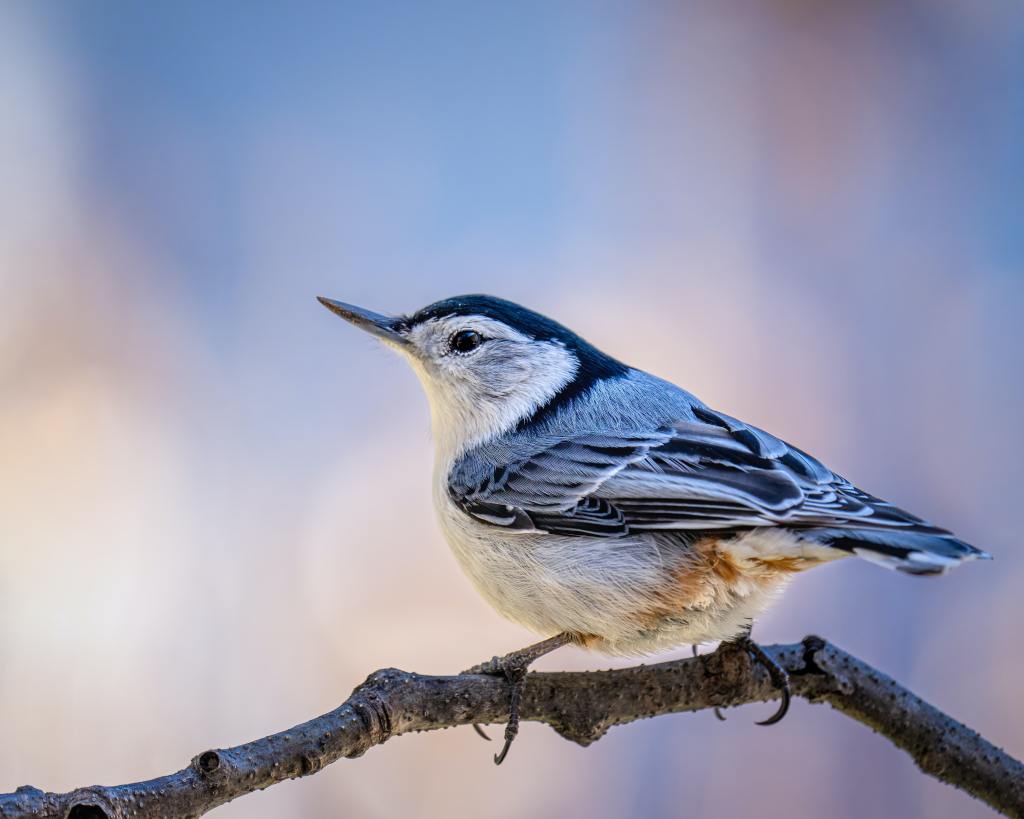
I turned immediately toward the sound only to see a little, gray bird crumple and fall to the walkway below the window. It was a nuthatch. It sat hunched on the pavement looking straight ahead, undoubtedly stunned by the blow that had suddenly interrupted its flight. As much as I wanted to gather it up to tend this poor little bird, I resisted, thinking that I might do more harm than good. Five minutes went by, it didn’t move. Ten minutes later, it remained in the same posture. By around fifteen minutes after the collision, it started to shake all over. As it shook, it tilted its head back till its beak was pointed straight up and it repeatedly opened and closed its beak. 

This continued for the next few minutes, body shaking, head tilted back, eyes closed, beak opening and closing. I expected that this was an indication that the little nuthatch was finally expiring after such a crushing blow. Sadly I went inside, not wanting to witness its last breaths, knowing that there was nothing I could do to help. I told my husband Michael about this poor creature and what I presumed was its demise. We gave our feathered friend its privacy for its final few moments.

A few minutes later we were back outside resuming our afternoon chores. But the nuthatch was shockingly gone!  It apparently had recovered enough to fly away. Hurray! But what was all that shaking and head tilting and beak opening about? And just as quickly as I asked that question, this is what occurred to me:

 “Have I ever flown into a window?

 Have I ever been going one direction and been dramatically stopped in my tracks?

 Has that experience left me stunned and disoriented?

 Has it taken me a while to recover? 

Has it shaken me to the core?

 Have I looked up to heaven and called out to God? 

Have I repeatedly called upon the Lord for help, for forgiveness for going my own way,

 for strength to go His way?” 

To all of these questions, my answer is yes. Am I grateful that despite the hurt, God has “stopped” me from going the way that I was headed? Absolutely. Would the nuthatch have fared well if it had been able to get through the window and enter the house? No, not at all. Neither would I have fared well if I had been able to have the career that I had planned, married the person that I thought was “the one”, or had no children so that I could pursue my dreams. 

What about you? Have you ever hit a window?

Has a sudden stop left you stunned and disoriented for quite a while?

Has this loss left you shaking and shaken?

Have you tipped your head heavenward?

Have you cried out to God again and again? 

If your strength is renewed, are you willing to fly in a new direction?

“Have you not known? Have you not heard? The Lord is the everlasting God,

the Creator of the ends of the earth. He does not faint or grow weary and his

understanding is unsearchable.

He gives power to the faint and to him who has no might, he increases strength.

Even youths shall faint and be weary and young men shall fall exhausted;

but they who wait on the Lord shall renew their strength. They shall mount up 

on wings like eagles;

they shall run and not be weary; they shall walk and not faint. Isa.40:28-31

I lift my eyes up to the hills. Where does my help come from?

My help comes from the Lord who made heaven and earth. Ps. 121:1

I bless the Lord who gives me counsel; in the night also my heart instructs me.

I have set the Lord always before me; because he is at my right hand, 

I shall not be shaken.

You make known to me the path of life; in your presence there is fullness of joy;

at your right hand are pleasures forevermore. Ps.16:7,8,11

Are not two sparrows sold for a penny? And not one of them will fall to the ground ` apart from your Father. Fear not, therefore, you are of more value than many 

sparrows.  Mt.10:29,31

Yes, you are of more value than that little nuthatch.

Consider the Sap

At the end of Jesus’ life, just before he entered the Garden of Gethsemane, he likely walked through the vineyards of the Kidron Valley with his disciples. He used this setting to help them to understand his relationship with them and theirs with him. We read about this in John 15 where Jesus tells them about his Father as the vinedresser, himself as the vine and his disciples as the branches. 

On a recent trip that my husband Michael and I took to Sicily, we stayed on the property of a vineyard owner. By interacting with him and watching him as he tended his precious vines, we were observing John 15 in real time, the tender care of the vinedresser, the resilience of the vine and the delicate dependence of the branches.In previous posts, I wrote about the vineyard, the vine dresser, the vine and the branches. Now we come to yet another character element to consider in this allegory, the sap.

 Hidden inside each vine and each branch is another component that is essential to the fruitfulness of the vineyard, the sap. If the branches are securely connected to the vine, (see the Consider the Branches post) all the water and nutrients that the vine gathers through its roots are dispersed to the branches through the sap. If the branches become disconnected from the vine, they quickly wither because the sap no longer sustains them.

In both chapters 14 and 16 of John’s gospel, which are part of Jesus’ vineyard discourse, he assures them that he is sending the helper, the Holy Spirit who will “take what is mine and declare it to you.” In fact this hidden helper, the Spirit of truth, cannot be received by those who are not connected to Jesus the true vine. But for those, like his disciples, who are connected through their faith in Jesus, their Savior and Sovereign, he says of the Holy Spirit, “he dwells with you and will be in you.” (John 16:15)

The hidden secret to a fruitful vineyard is the sap. We don’t see the sap, but we certainly see the results of its steady and nourishing flow. If the vine is well tended and its roots are secure, if the branches are firmly connected to the vine in the proper location, then the conditions are in place for the lifeblood of the vine to provide for the branches’ growth and fruitfulness.

This brings me again to think about the role of the Holy Spirit in the life of every one who has surrendered to Jesus and said yes to Him as their salvation. The Holy Spirit leads us to grow more and more securely and deeply connected to Jesus. He pours into our lives his life transforming sap of  truth, counsel, comfort, conviction of sin, correction, boldness, freedom from sin and self, drip by drip, little by little. Just as we cannot see the growth of a branch from one day to the next, neither does the work of the Spirit in our lives produce instant transformation. 2 Cor.3:17-18 describes the Spirit’s work this way:

Now the Lord is the Spirit, and where the Spirit of the Lord is, there is freedom!

And we all, with unveiled faces, beholding the glory of the Lord, are being 

changed into His likeness from one degree of glory to another. For this comes from the Lord, who is the Spirit.

One degree at a time is quite imperceptible, but degree by degree the Spirit transforms  us so that we come to resemble our Creator and Savior in both character and impact.

Another thing that the Spirit produces in the life of the human branch is fruit. These are outward character changes that reflect the inward reality that we are children of God.

But the fruit of the Spirit is love, joy, peace, patience, kindness, goodness, 

faithfulness, gentleness and self-control; against such things there is no law.

Galatians 5:22

And when they had prayed, the place in which they were gathered was shaken,

and they were all filled with the Holy Spirit and continued to speak the word of God with boldness. Acts 4:31

This kind of fruit is the fruit of a Spirit-saturated life which over time matures us such that we grow to resemble Him! 

In the letter of Paul to the church in Rome, he uses in an analogy a practice that was well known in the ancient world, the practice of grafting branches into a root stock. In this analogy, he is telling these non-Jewish believers in Christ that they have been grafted into the root of God’s work of redemption in the world that was carried forward through the Jewish people. But now, these Gentile Christians, whom he calls “wild olive shoots”, are grafted into the cultivated olive tree such that they “now share in the nourishing root” (Rom.11:17) He also reminds them of the natural order of things. “Remember that it is not you who supports the root, but the root that supports you.” (Rom.11:18) 

The act of grafting involves cutting off a branch from, in this case, a wild olive tree, slicing a notch into the cultivated tree, into which the graft is inserted. These are then bound together and the graft “takes” once the sap from the parent tree flows into the cutting. Thus it becomes a partaker of all that the nourishing root supplies through its sap. It is the life of God, the Holy Spirit, the source of our spiritual life, who produces outward evidence of that life, which is fruit.

For me, the recognition of the Holy Spirit was indeed hidden for the first two decades of my life as a child of God. I read about the Holy Spirit in scripture, sang songs about the Spirit but had little awareness of the crucial part that the Holy Spirit played in my life as a child of God. My dear California friends and a spunky Spirit-filled eighty year old counselor helped me to recognize, invite, yield to and depend upon the Spirit to do what my own flesh could never do. In Inviting the Holy Spirit to take over, it was as if a constriction was removed so that His powerful sap could flow more freely. Indeed as it says in Romans 8:6 that, “to set the mind on the flesh (my own natural strength and ability to live my life to please the Lord) is death (failure over and over again!), but to set the mind on the Spirit is life and peace” It is true! Inviting the Holy Spirit to take over, depending on the hidden work of the Spirit to strengthen, lead, transform, give boldness and courage, give power to obey etc., is the hidden work that brings life and peace. He truly does what I could never ever do apart from Him.  

What about you?

How do you understand and relate to the Holy Spirit and his work in your life? 

How does this simple illustration of the sap flowing from the vine into the branches give you new insight into the Holy Spirit’s role in your life?

How much of your Christian life is based on you trying your hardest to become like Jesus and working to produce fruit for God? 

How do we detect when we are relying on our own strength and when we are letting the Holy Spirit be the hidden yet transformative source of our will and work?

Is there evidence in your growth and in the fruit of your character and works that you are well connected to Jesus?

 Are there steps of obedience to take that might make your connection with Him deeper?

“I tell you the truth; it is to your advantage that I go away, for if I do not

go away, the Helper will not come to you. But if I go, I will send him to you. Jn.16:7


Consider the Waterfalls

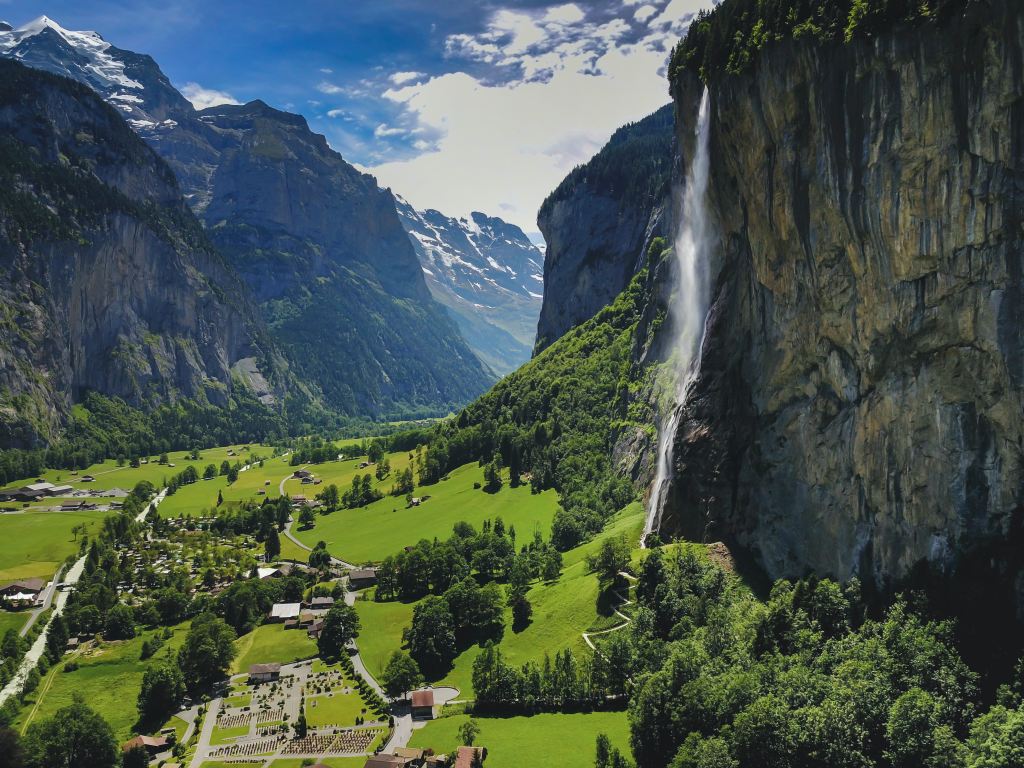
The Lauterbrunnen valley in Switzerland is absolutely stunning. It is home to 72 waterfalls that tumble off the 90 foot encircling cliffs into the verdant valley below. Thanks to my husband’s employment with a Swiss based company for a number of years, we have enjoyed the privilege of extra excursions to this extraordinary place. There is one waterfall, the Staubach falls, that matches one’s vision of a quintessential Swiss waterfall cascading behind the steeple of a quaint church which is nestled in the iconic village of Lauterbrunnen. As surreal as this picture appears to be, I can testify that it really does exist and is more beautiful than the pictures can possibly capture. 

What does the river look like before it becomes airborne, plunging into the valley below? What does it sound like? Our family, and perhaps me moreso, wanted answers to these questions. To find answers required a hike from the valley floor, traversing back and forth as the trail switch-backed across the headwall and ascended into the pine covered slopes leading up into the mountains. After crossing stream after stream, we finally reached a bridge with a sign indicating that this was at last the Staubach river. It was pulsing with snowmelt from the mid-May temperatures and I stood on the bridge watching and listening. Rev.1:15 tells us that, “his voice is like the roar of many waters.” So I paused, waiting to receive any message that the roar of these waters might contain. To my surprise, these are the words that came to mind, “Can you stop the flow of this river? Can you hold back these waters?”  What a ludicrous question, I thought to myself, given the volume of water and the force of its flow. I could not imagine resisting, no less stopping this rushing river. It would be utterly futile to even try. As I pondered the first statement, a second came to mind.  “Even so it is futile to try to thwart will or stop my purposes. I am coming.” I could imagine Job standing beside me on the bridge, seeing the unstoppable flow of the water and declaring,

“I know that you can do all things,

And that no purpose of yours can be thwarted.” Job:42:2

At some point, maybe 50 yards below where I stood on the bridge as it spanned the river, the ground would give way. At that point the river would hurtle off the top of the cliff and become airborne, dividing into billions of tiny droplets flowing through space, forming the misty plume that plunged toward the valley below. 

If the flow of the river represents truth and ground represents time, while the river still clings to the side of the slope, there will be time for those who would resist and even try to reverse the flow. They might say,  “There is no truth, there is always more time, there is no God.”  But the river flows nevertheless and the water eventually makes its way around all obstacles as the inexorable flow of the river propels each tiny droplet down the mountain until suddenly the ground is no more – time runs out – life as we know it ends and we are hurtled into eternity. What then of truth and time and God?

If I thought that the Staubach waterfall was impressive and powerful, and it is, I was about to be overwhelmed by what I saw next. On the other side of the valley, hidden from view, is another cascade, the Trummelbach Falls. To access this waterfall required a hike toward the headwall. There, exploding from the side of the mountain, with the force of a hundred thousand water cannons, was the exit point for the Trummelbach. The thought of being met by the magnitude of such power actually gripped me with terror as I clung to the railing of the walking path. It was crazy, but then it got crazier. From there the pathway went inside the mountain to follow the course of the river as, over the millenia, it had actually carved its way into the rock of the headwall. If I thought that the waters of the Staubach river roared, I was about to understand what that word, roar, actually meant. The experience is hard to describe. If you Google Trummelbach Falls, you can see a video that might give you an idea of the sound. 

Absolutely deafening! In addition to the sight of the ragingly irrepressible waterfall and its sound as it smashed its way through the rocky crevasses and twisted canyons, was the feel under our feet. The mountain around us was quaking and shaken by the very force of the torrent. 

The fear of the Lord is a fountain of life,

Who could possibly stop this flow? One would be dashed into pieces to even attempt it. There was a healthy awe and also a healthy fear that came over us from being in the presence of such magnificent power. If this is what we feel and hear and see in the presence of the creation, how much more the Creator. But rather than fear that causes one to draw back, His is the fear that gives those who know and love Him, strong confidence that He is God and that there is none greater. 

“In the fear of the Lord one has strong confidence,

And his children will have a refuge.

and his glory from the rising of the sun;

That one may turn away from the snares of death. Prov.14:26,27

Let all the earth fear the Lord;

Let all the inhabitants of the earth stand in awe of him!

For he spoke, and it came to be;

he commanded and it stood firm. Ps.33:8,9

I am God and there is no other;

I am God and there is none like me,

Declaring the end from the beginning

And from ancient times things not yet done,

Saying my counsel shall stand and I will accomplish all my purpose…

I have spoken, and I will bring it to pass;

I have purposed, and I will do it. Isa. 46:9-11

So they shall fear the name of the Lord from the west,

“The fear of the Lord is the beginning of wisdom;

for he will come like a rushing stream,

which the wind of the Lord drives. Isa.59:19

So what do you think as you read this post?

Have you ever tried to stop the flow of the river or perhaps alter its course? 

Does the flow and force of the water comfort you or does it frighten you or perhaps anger you? 

What do you think about the analogy of the flow of the river being like truth or the purposes of God, the ground representing time, and the cliff and empty space below analogous to the end of our time on earth and our entrance into eternity? Do you agree? Do you see these differently? And what of the statement, “I am coming.”? Is that comforting, alarming, irrelevant?

Consider the verses at the end of the post and let me add one other, 

all those who practice it have a good understanding.” Ps.111:10

Thanks for reading.

Martha


How to Fight God’s Way: Principle 14


Fight for Future Generations

One generation shall commend your works to another, 

And shall declare your mighty acts. (Ps.145:4)

Are the battles that I have written about against internal and external foes actually worth fighting? Would it be so bad to leave these strong enemies unconfronted and quietly live out peaceful, God-honoring lives away from the fray? Afterall warfare is dangerous and exhausting and perhaps it is not worth the fight for the seemingly slender territory to be gained. Even David must have wondered the same thing. What if he gave up on the anointing that he had received from Samuel to become Israel’s king and returned to the simple life of being a shepherd, or if he relented in inviting God to examine his internal landscape and settled for just being good enough, what would it really matter? God would surely raise up someone else to accomplish His will.

But David sees something else beyond the gains for his own soul or for his kingdom. He sees that these battles have implications for generations to come. The baton of faith is meant to be passed from generation to generation. The fight is not just for us, but for them. Our children, the next generation, are watching to see if we will fight the good fight of faith because He is worthy and they are worth it. 

In Ps.145 David foresees the response of a next generation who love and follow God with a whole heart. He speaks of them in this way; “They shall speak of the might of your awesome deeds.” and “They shall pour forth the fame of your abundant goodness.” (Ps.145:6,7) The bold faith of the next generation is inextricably linked to David as he declared to them the greatness of his God who trained his hands for war and his fingers for battle. 

I will close this series of posts with a few reflection questions. But I also would like to thank you for taking your time to read these musings. As I have said, this is not an exhaustive study on spiritual battles. There are a lot of training principles elsewhere in scripture. May these add additional thoughts to fuel all of us as we take our stand against our adversaries in God’s way.

What battles are you facing?

Do you believe that God is greater than the opponent you face?

Do you trust in his unfailing love for you despite the difficulties you are facing? 

Is it your inclination to run to the battle lines?

If so, have you let him train your hands for war and your fingers for battle? 

Are you seeking God, submitting to his will and waiting on his instructions? 

Are you being led by his Good Spirit for his glory and name’s sake? 

Is it your inclination to shrink back from the battle and seek comfort and security?

Are you seeking God, listening for his instructions, willing to do his will?

Are you letting his Good Spirit lead you for his name’s sake, to glorify him?

Have you considered how fighting your battles in God’s way will impact future generations?

Have you shared your battle stories with others and boasted about what God has done?


How to Fight God’s Way: Principle 13

Worship him

    I will sing a new song to you, O God;

Upon a ten-stringed harp I will play to you. (Ps.144:9)

Worship is war. This verse is sandwiched between David’s plea to “stretch out your hand from on high and rescue me” and “rescue and deliver me from the hand of foreigners, whose mouths speak lies and whose right hand is a hand of falsehood.” Things on the battle fronts are not going well and yet David sings a new song to God. Perhaps the Holy Spirit instructed him to do so. Perhaps he used music as a familiar pathway to draw near to God and to express his heart to Him. Either way it is quite stunning for David to pull out his harp and compose a song at such a perilous time. Though there are moments in our battles that require the utmost urgency, most do not. It requires exercising faith and trust in our God who can fight our battles in his way and in his time, to pause and worship. 

Indeed we see God lead King Jehoshaphat to employ worship as the chief weapon when faced with a coalition of three invading armies. In the account of Jehoshophat preparing to face these external enemies, we see many of the same training principles that David wrote about.

When he first hears that these armies are advancing we read, “Then Jehoshaphat was afraid and set his face to seek the Lord and proclaimed a fast throughout Judah.” Then he stands in the assembly of all the people declaring to God in prayer, “In your hand are power and might, so that none is able to withstand you.” He humbly acknowledges in front of all the people that these enemies are too strong for them. “We are powerless against this great horde. We do not know what to do, but our eyes are on you.” Then we read that God answered by the Spirit coming upon Jahaziel to prophecy. “Thus says the Lord God to you, ‘Do not be afraid and do not be dismayed at this great horde, for the battle is not yours but God’s’.” Jehoshaphat’s first response to this word is to fall down before the Lord and worship. The next day he speaks to the people saying, ”Believe in the Lord your God and you will be established.” Then he appoints those who are to sing to the Lord this song as they approach the enemy for battle:

Give thanks to the Lord,

For his steadfast love endures forever.

Not only did Jehoshaphat appoint singers, not only did he request that they sing this song, but he placed them as the vanguard of his army. Worshipers were the front-line troops! “When they began to sing and praise, the Lord set an ambush… and they [the invaders] all helped to destroy one another.”

In this example, worship and praise are both Jehoshaphat’s response before the battle and his weapon in the battle. “Tomorrow go out against them and the Lord will be with you.” Worship affirms that the battle is truly the Lord’s. (all quotes from 2 Chron. 20:3-23) 

Worship helps us to remember who God is. Worship lifts our gaze off of our adversity. Worship clears the clutter of fear and confusion. Worship opens our ears to His will and His direction. Worship trains, equips and fights.


How to Fight God’s Way: Principle 12


Receive his Provision and Protection

He is my steadfast love and my fortress,

my stronghold and my deliverer, 

my shield and he in whom I take refuge,

who subdues the peoples under me. (Ps.144:2) 

This is the verse immediately following the acknowledgment by David, that it is God, his rock, who trains his hands for war and his fingers for battle. But notice how many times he uses the word, my. I count six. God is my rock, my steadfast love, my fortress, my stronghold, my deliverer, my shield. How would it be different if David substituted the words a or the for the word my? So very different because it would no longer be personal. Battles are best fought, not with concepts but with a Person. David grew to know God personally as he let him lead him. He got to know God intimately when he ran to him for refuge, when he asked him for wisdom or when he bared the depths of his soul before his God whom he grew to know and trust. 

How would it be different for you if you proclaimed this verse over the internal or external struggles you face? In the magnificence of who God is, he delights for each of his blood-bought children, to call him, my God. When waves of accusation come at me, he is my shield. When confusion clouds my ability to know what to do, he is my refuge and deliverer. When I have experienced setbacks, he is my rock and fortress. When I have messed up, he is my steadfast love. I can proclaim that this is who God is even before I experience him in these ways. In that way, my faith is strengthened and he is honored as who he is and always will be.


How to Fight God’s Way: Principle 11

Bring honor to God’s Name

For your name’s sake, O Lord, preserve my life!

In your righteousness, bring my soul out of trouble! (Ps.143:11)

Why do I want to win my battles? Why do I want to overcome fear? Why do I want to parent my children well? Why do I want to see justice in legal battles? Why do I want righteousness laws in our country? Why do I want to win an argument and silence my adversaries? Is it for me? Is it for God’s honor? Is it both? Who gets the credit for a battle won? These are tough questions that I have asked myself many, many times. David has someone else in view when he cries out, “Preserve my life!”, “Bring my soul out of trouble!” He is asking for help for his own sake for sure, but he wants his victories to showcase his God. In the preservation of David’s life, God is revealed as healer, protector, deliverer, compassionate. In bringing David’s soul out of trouble, God is revealed as righteous, truthful, merciful, forgiving. 

In training our hands for war and our fingers for battle, under whose banner do we serve? Is it the banner of pride that says, “I am right and you are wrong” or that says, “ I am the winner”? Is it the banner of comfort that says,” Everyone likes me and everything is to my liking”? Is it the banner of self that exalts my determination, my wisdom, my courage, even my self-righteous ability to be a “good” Christian? 

How much sweeter to vindicate God’s magnificent name. As God shows up, we get to boast in Him. I recall a time long ago, we were traveling with 4 of our 6 children who were between the ages of 7 and 2. We had stopped at a rest area to give everyone time to get out of the car and a passerby commented favorably on the behavior of our children. “How do you get them to behave so well?”, she asked. Well I went off and described my approaches to discipline, blah, blah, blah. She left and I felt sick. I had not once acknowledged how the Lord had fought for me, with me, for them. I had not mentioned how often I had come crying to him and he heard my cries and helped me. I purposed in my heart after that repulsive experience of waving the ugly banner of self-sufficiency, that I would run under the banner of his name and boast in him. 

David concludes Ps.143 with these words, “I am your servant.”  As his servant, David’s deepest desire was to bring honor and glory to his God. Under whose banner do you serve?


How to Fight God’s Way: Principle 10


Be led by the Spirit

Let your good Spirit lead me on level ground. (Ps.143:10)

The Holy Spirit, God in us, is able to lead us in our external and internal struggles. This truth is evident throughout scripture. In Zechariah 4 the angel imparts the word of the Lord to Zechariah the prophet for Zerubbabel the governor, who was up against the external challenge of rebuilding the temple. “Not by might, nor by power, but by my Spirit, says the Lord of hosts.” (Zech.4:6)  Zerubbabel was instructed through this prophecy to let the Holy Spirit be the general contractor for this difficult task. Paul shares a similar exhortation to the church in Galatia, as they were being tempted to accomplish inner transformation through their own efforts. “But I say, walk by the Spirit, and you will not gratify the desires of the flesh.” (Gal.5:16) For both internal and external struggles, David appeals to the “good Spirit” for direction.

 The Spirit is the Helper that Jesus repeatedly spoke of to his disciples in his final conversations with them before his arrest. ”And I will ask the Father and he will give you another Helper to be with you forever, even the Spirit of truth.” (Jn.14:16)  “But the Helper, the Holy Spirit, whom the Father will send in my name, he will teach you all things and bring to your remembrance all that I have said to you.” (Jn.14:26) “When the Spirit of truth comes, he will guide you into all truth… for he will take what is mine and declare it to you.” (Jn.16:13,14)

And the resurrected Lord Jesus Christ reminded his disciples to wait in Jerusalem for the coming Holy Spirit through whom they would receive boldness and power to be his witnesses.

In our battles, God is not only for us, he is within us. This is why Jesus said that it was better for them if he left since then by his death and resurrection, the Holy Spirit would be able to come. The apostle Paul writes in Phil.2:13 that, “it is God [Holy Spirit] who works in you both to will and to work for his good pleasure.” 

All of this is great news! How is it made real in our lives? David uses a simple three letter word – let. Let acts as the release valve that dispenses what the Spirit wants to impart on our behalf. We need to give the Spirit permission. We need to ask. Let suggests trust, let involves faith and a willingness to yield. David not only uses the word let but he trusts that the Spirit is good. All of the principles that I have shared thus far could be summed up in letting the good Holy Spirit lead, direct, remind, instruct, reveal truth, convict of sin, give boldness and courage.

Whether we feel these things or not, we can rely on the truth of God’s word that all that  God promises through the Holy Spirit is available to those who have put their faith in Jesus. Ask God, the good Holy Spirit, to help you.


How to Fight God’s Way: Principle 9

Submit to His will

Teach me to do your will,

For you are my God. (Ps.143:10)

What is God’s will regarding the battle you are facing? Jesus wrestled with the very same question in the garden as he pleaded with his Father, “My Father, if it be possible, let this cup pass from me; nevertheless not as I will, but as you will.” (Mt.26:39) Jesus dreaded the cost he would incur in his epic battle to free humanity from the wages of their sin by paying it all in full by his own death. Nevertheless Jesus said that he would submit to the Father’s will. How does God want to use our fingers and hands to accomplish his will? 

If it were up to us, all battles would be waged and won in a decisive, timely, tidy and victoriously glorious manner. Illness would be miraculously healed, adversaries would be silenced, relational rifts would be reconciled, inner wrestling would be soothed, and all of these done quickly. Though we know that these are possible, we also know that this is not always the case. What is God’s will as he trains our hands for war and our fingers for the particular battle we are engaged in? Are my desires, even my expectations for a particular outcome surrendered to and in keeping with His will?

“ Keep teaching us to desire and submit to your beautiful will, for you are our God and you alone are God.” This is how I might paraphrase this verse to emphasize that instruction in God’s will is a process and that God is God. God being God means that his will is higher, deeper, purer, more excellent, more far reaching, more to be desired than my preferences. His will is beautiful in ways that I can not fathom. His will cares for my desires but is not held hostage to them. Keep teaching us therefore to discern and desire Your will.


How to Fight God’s Way: Principle 8

Run to Him for Refuge

Deliver me from my enemies, O Lord!

I have fled to you for refuge! (Ps.143:8)

While we might imagine that David was always the first to run to the battle lines to confront his enemies, this was not necessarily the case. “I have fled to you for refuge” recounts David. The word refuge is a word for covering, concealment, engulfing, hiding.

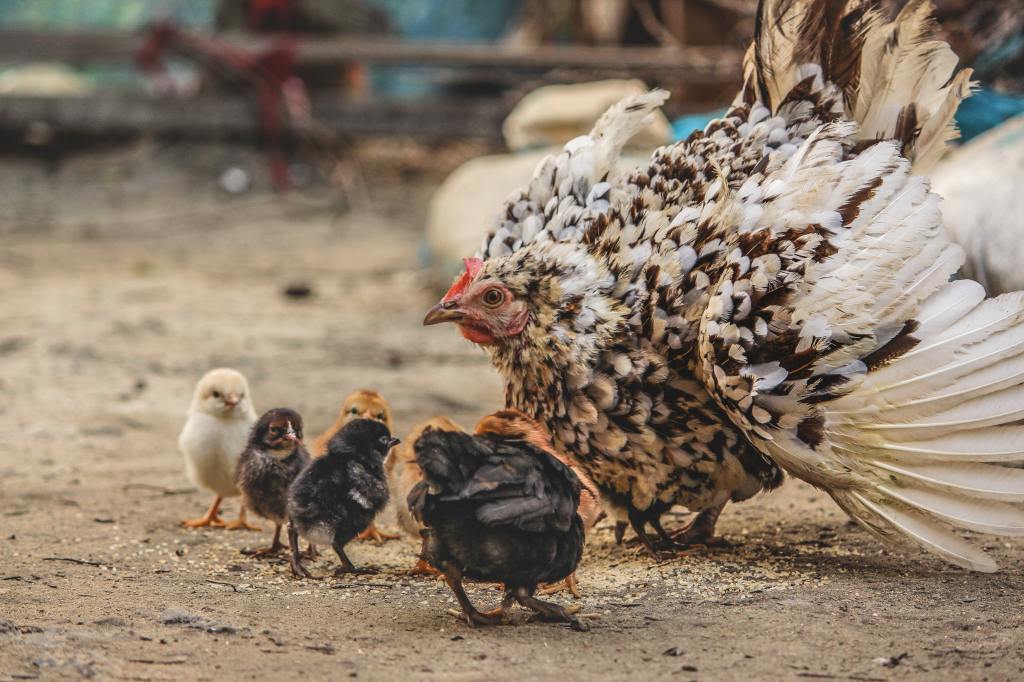
Fleeing for refuge reminds me of a mother hen with her little brood of chicks, who happily scamper in her vicinity until a shadow passes and then without a moment’s hesitation, they run under the hen’s outstretched wing until the threat is gone. This is what is depicted in Ps.91:4, “He will cover you with his feathers, and under his wings you will find refuge.”

Sometimes it is best to hide. One does not always need to take an offensive approach to confronting an enemy. One tactic in battle is to hide, to seek refuge and where better than under the outstretched arms of our God. Part of our training in war and in battle is discerning when to pull back and seek refuge. This is not a retreat of cowardice but of wisdom. If we don’t know what to do, it is better to hide ourselves and wait upon the Lord for his instruction and help than to stand up to the enemy, only to find out that we are all alone.