Consider the Vinedresser

Martha Fletcher

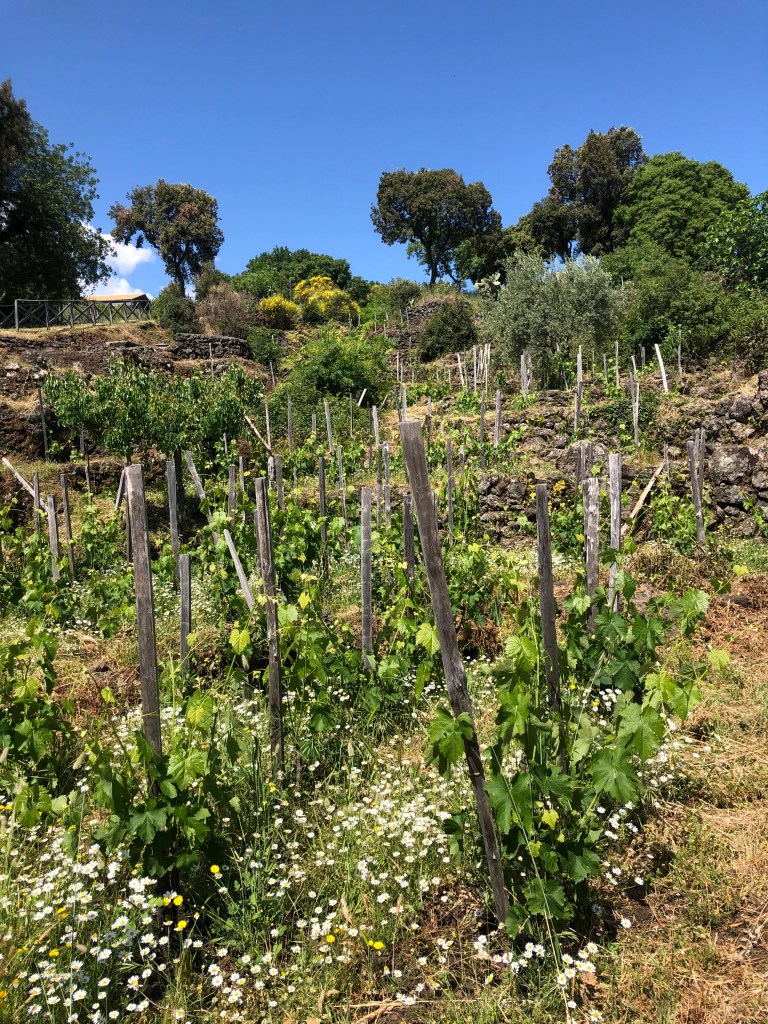
 Our scruffy Sicilian host did not initially reflect our preconceived images of the keeper of the Biblical vineyard. Where the resemblance began to take shape was as he walked among his beloved vines. He addressed them by name, not that each vine had a name, but he spoke of them as “she”. “ She is growing so well. Look at how beautiful she is. She is a hundred years old and she is still producing fine grapes.” The love that this man had not only for his vineyard, but also for the individual vines, was stunning.

 His love not only motivated him to care for them, his love cost him dearly to procure them. He described how the care for this old vineyard had been forsaken by the previous owners. Four children had inherited four quadrants of the property from their forefathers who had planted the vineyard and tended it. The children, having no interest in the constancy of work required to keep the vineyard productive, had left it untended for decades. Our host described the years of negotiation and cost to approach each owner and convince them to sell their portion of the property. He would not settle or be satisfied until he had procured the entirety of the original vineyard.

Our heavenly vinedresser has also gone to exorbitant ends to procure for Himself the entire vineyard, even in its untended, overgrown, unproductive state. From the four quadrants of the earth, he is gathering a people for Himself, from every tribe, tongue, people and nation. But it came at an exorbitant cost, His one and only Son. 

Revelation 5:9 states,” And they sang a new song saying, 

‘Worthy are You to take the scroll and break open its seals;

For You were slaughtered and You purchased people for God

with Your blood from every tribe, language, people and nation.’”

Once the vineyard belonged to our host, he went to work to restore it to become fruitful once again. He first cleared the stones that had thrust up out of the ground. He walked us past an enormous pile of volcanic rocks that had to be extracted as they interfered with the growth of his vines. He cleared stones, he removed the overgrowth of weeds and briers that were suffocating the plants, he pruned off the overgrown, unproductive branches that had been left on the vines for years, diverting the energy of the plants from bearing fruit. He optimized the soil around the plants to receive nutrients and receive the supply of seasonal rain. He tilled around the base of each vine, cutting off the superficial roots so that the plant’s roots would grow deep and access the more constant supply of water that resided well below the surface. He repaired the fencing around the property to prevent animals from coming in and ruining his crop. However, even as he described the enormous amount of work that went into restoring his vineyard, he did not describe it as a labor of drudgery, but he described it as what was necessary to see this vineyard fulfill its original purpose, the production of excellent grapes.

For our host, tending his vineyard was clearly a labor of joy and love. This resurrected vineyard is truly his delight and the vines are his individually known and cared for children! 

Our encounter with a human vinedresser gave me a glimpse into the heart of our heavenly vinedresser, our Father.  Isaiah captures this sentiment in his love songs of chapters 5 and 27. This theme is also echoed by Jesus when he took his disciples through a vineyard on his way to Gethsemane. Hear in these passages the passion of the vinedresser:

“Let me sing for my beloved my love song concerning his vineyard:

My beloved had a vineyard on a very fertile hill.

He dug it and cleared it of stones and planted it with choice vines;

He built a watch tower in the midst of it and hewed out a vat in it;

And he looked for it to yield grapes…” (Isa.5:1-2)

“A pleasant vineyard, sing of it!

I, the Lord, am its keeper:

Every moment I water it, lest anyone punish it.

I keep it night and day.” (Isa.27:3)

“I am the true vine and my Father is the vinedresser.

As the Father has loved me, so I have loved you. Abide in my love. (Jn.15:1,9)

While I don’t want to overstretch the analogy of our human vineyard owner to our Father, the vinedresser, I couldn’t help but draw spiritual lessons from some of what I observed. Not only did our host take pains and cost to procure this vineyard, and not only does he love his vineyard, but in order to make it productive, he prunes the vines and tills the soil. Tilling had many purposes. It loosens the compacted ground so that water could penetrate more readily and it creates air pockets so that the roots could breathe. I could see the parallels to principles of growth as Christ-followers in these two benefits of tilling. But it was tilling to remove the superficial roots that most caught my attention.

 Sicily has a wonderfully difficult climate for growing grapes. This vineyard on the slope of Mt. Etna receives rainfall and snow melt in winter and spring, but the summers are very hot and dry. If the vines are watered continually from above, their root systems will become superficial and will not be able to sustain the plant during the long, hot dry season. By cutting off the top roots as the dry season approaches, the vines are forced to send their roots downward into the aquifer below. The vinedresser not only prunes what grows above the ground, he also prunes what lies beneath the surface. It seems harsh, but it is for the vine’s ultimate good.

Shallow roots do not sustain a vine. Shallow faith cannot sustain us either. The loving vinedresser may need to force our roots to go deep, deep into his word, deep into knowing His unchanging character, deep into trusting His word and character when things on the surface get “tilled”, broken up, upset, chopped. The consequences of not doing this are dire. Jesus describes this in his explanation of the parable of the soils in Matthew 13.

“Other seeds fell on rocky ground, where they did not have much soil, and immediately 

they sprang up, since they had no depth of soil. But when the sun rose, they were 

scorched. And since they had no [deep] root, they withered away.

As for what was sown on rocky ground, this is the one who hears the word

and immediately receives it with joy, yet has no root in himself but endures for a while.

And when tribulation or persecution arises on account of the word, immediately he falls 

away.” (Mt.13:5,6,20,21)

The vinedresser both removes the stones and cuts the top roots so that what is pictured above does not come to pass. The application in my own life is immediate as I think back on those difficult times, deep disappointments and losses as events and seasons that over time deepened my faith in and love for Him. Were it not for those struggles, I would not know the Lord, I would not lean into Him and trust Him like I do today. 

The picture of the growth that such tilling produces is described by Jeremiah as he contrasts the desert shrub (whose root system is superficial, like the tumbleweed) to the tree.

“Blessed is the one who trusts in the Lord, whose trust is the Lord.

He is like a tree planted by water that sends out its roots by the stream,

and does not fear when heat comes, for its leaves remain green,

and is not anxious in the year of drought, 

for it does not cease to bear fruit.” (Jer.17:7-8)

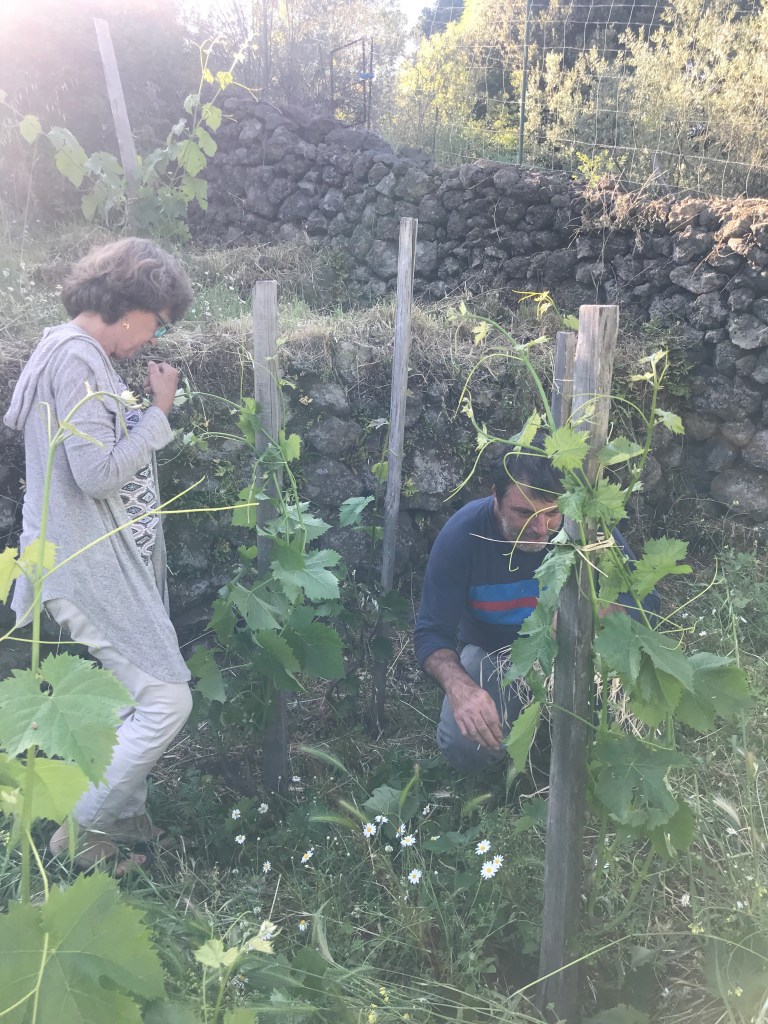
Another time that we shared with our vinedresser host occurred on the final day of our stay. It was late in the day as we were driving in to town for a few groceries, when we noticed our friend, alone, in his vineyard moving from plant to plant, stooping over each one, gathering in his outstretched arms the drooping branches and gently tying them up to a central stake. We abandoned our trip to town to join him in the vineyard. Over the next several hours, he instructed us in this critical stage of tending the rapidly growing plants. Each vine had numerous tender, leafy branches that had grown out of the woody vine. As they grew longer, gravity would pull many of these tender shoots downward. Our host shared that the branches were especially vulnerable at this stage of their young growth. A strong wind or heavy rain could easily break off the immature branches unless they were lifted up and secured. Around his waist he had a sack of natural twine. He would stoop low next to each vine, stretch out his big arms to gather the verdant and vulnerable branches and then as he held them in place, he would gently tie them to the central stake. We became his apprentices. “Don’t tie them too tightly. Just enough to hold them up.” But as he was tying up the branches, he was also inspecting them to see which ones had tiny clusters of immature grapes, which branches were suckers and which branches needed their leaves thinned so that the sun could fall on the developing grapes to ripen them. He pruned as he went and he pruned each vine uniquely. For each vine he considered both the overall health of the plant and the production of fruit. 

I have reflected so many times on the image of our burly vinedresser friend with outstretched arms stooping low to tenderly gather up the weak leafy branches in his strong arms and then gently holding them as he formed a loose knot with the twine so that they would be protected. 

John 15:2 tells us about this function of the vinedresser. “Every branch in Me that bears no fruit, He takes away and every branch that does bear fruit, He prunes that it may bear more fruit.” The common words that Bible translators use for the Greek word aero are take away. Other translators however use an alternate definition of this word aero: to raise up, lift up, prop up. The Passion translation uses this definition in John 15:2;

“He cares for the branches connected to me by lifting and propping up the fruitless branches and pruning every fruitful branch to yield a greater harvest.” (TPT)

This is what I saw. I saw the human vinedresser examining the branches, inspecting them to see that they are properly connected to the vine, and if properly connected but misoriented, growing downward instead of upward, gently lifting and securing them so that they might become fruitful.( For a deeper discussion on this see the article John15:2 “Lift Up” by Paul Bucknell at bffbible.org.)

 Have you ever lost your orientation? I certainly have – looking downward at my circumstances, growing in a worldly direction, downtrodden by a deluge of difficulties, looking for fruit and fulfillment in the wrong places, with wrong expectations. Certainly when Jesus spoke these words to his disciples, it was just before they would all abandon him, deny him and hide in fear. They were definitely disoriented branches who showed little evidence of fruit. But Jesus did not cut them off. Rather the resurrected Christ came to them, spoke peace to them, stretched out his arms to show them his scars and wounds and lifted them back to their proper orientation toward himself.

“All that the Father gives to me will come to me; and the one who comes to me I will most certainly not cast out.” Jn.6:37

Well the last experience that we shared with our vineyard owner friend was after we had spent hours with him, pruning and tying up branches. We had used up all his twine and the sun was setting. With a satisfied sigh, he gazed at his vines. “They look very good”. And then turning toward us he said, “We must celebrate our work together!”

With that we climbed the hill to our cottage. He invited other guests and workers to join in the celebration on our patio. We opened the wine that his vineyard had produced years prior and celebrated a well tended vineyard accompanied by a pyroclastic display from the top of the looming Mt. Etna. 

Our God is a celebratory God! 

On this mountain the Lord of hosts will make for all peoples a feast of rich food,

a feast of well-aged wine, of rich food full of marrow, of aged wine well refined. Isa.25:6

Blessed are those servants whom the master finds awake when he comes. Truly I say to you, he will dress himself for service and have them recline at table, and he will come and serve them. Lk.12:37

But the father said to his servants, “Bring quickly the best robe, and put it on him, and put a ring on his hand and shoes on his feet. And bring the fattened calf and kill it, and let us eat and celebrate… It was fitting to celebrate and be glad, for this your brother was dead and is alive; he was lost and is found. Lk.15:22,23,32

Let us rejoice and exult and give him glory, for the marriage of the Lamb has come and his Bride has made herself ready; it was granted her to clothe herself with fine linen, bright and pure – for the fine linen is the righteous deeds of the saints. And the angel said to me, “Write this: Blessed are those who are invited to the marriage supper of the Lamb.” And he said to me,”These are the true words of God.” Rev.19:7-9

How much more in all aspects is our Father God, the keeper and nurturer of his vineyard of souls. He purchases us and works on our behalf because he loves us. He tends us each uniquely, he lifts us up and tethers us to himself, he prunes us both above and below so that we might be strong and fruitful in Him. And he then celebrates in anticipation of the fruit that will be borne from our lives, which is our deepest joy and for his great glory. Finally, He invites us into the greatest celebration that the universe has ever known, all because of his own costly work of sacrificial love and mercy to redeem and restore an untended people. 

What do you see in this reflection?

 A new picture of our Father, the heavenly vinedresser, who lovingly works in his vineyard of souls?

 A new recognition of the work that He might be doing in your life so that you would be deeply rooted and fruitful?

 A glimpse of his tenderness toward misdirected growth and his outstretched arms to gather you up?

A celebration in anticipation of the harvest of delicious fruit from your life? 

Other vines that He longs to purchase and restore to Himself?


A Road Trip through the Letter to the Philippians

Pexels: Alexey Komissarov

The letter to the church of Philippi, written by the apostle Paul, stands out as a book filled with points of rich encouragement and expressions of pure joy. These themes may seem ironic, since this letter was written by Paul from dank Roman prison. In his writing to this beloved church, Paul discloses the principles and practices that enabled him to continue forward on his journey of faith, no matter the circumstances in which he found himself. He is neither thrown off course nor deterred in his pursuit. Pursuit of what? JESUS!

Paul is perpetually propelled by this singular desire to be as closely united with his Savior and Lord as is humanly possible in this life. He seeks to intimately know Jesus and make Him known. So in this road trip illustration of the letter to the church in Philippi, the journey begins with Jesus and ends with Jesus.

Just as any major roadway has guardrails to keep one from veering off, so too there are guardrails for Paul’s life in Christ as well: the love of God and the kingdom of God.

Fundamentally this journey is a depiction of a love relationship between our Creator and his ransomed creation; Him loving us by sending His Son to live, die and rise again for us, us receiving His love and loving Him back with our worship and obedience. Love from God and for God can’t be contained. It overflows to those around us. “It is my prayer that your love may abound more and more with knowledge and all discernment, so that you may [scrutinize those things that are of eternal value]”(Phil.1:9) Love from God and for God keeps us on the right road. This is one of the guardrails on the journey of faith that keeps him centered. Jude succinctly restates this thought in his letter saying, “keep yourselves in the love of God” (Jude 21). 

The other guardrail is the advance of Christ’s kingdom on earth. Despite writing from prison, Paul nevertheless believed that his capture and imprisonment was not an indication that God did not love him. No, the guardrail of God’s unshakable love was securely in place within his heart. Nor did he accept that his circumstances had divorced him from his calling to advance the kingdom of God on earth. He can still write letters (which we continue to be blessed through today) and he can inspire others through his boldness and confidence even as he suffers in shackles. As well,  he can make known to the whole of the Praetorian guard (to whom he is shackled) the gospel of Christ. “I want you to know brothers and sisters, that what has happened to me has really served to advance the gospel!” (Phil.1:12-14) As long as he is alive, he knows that there is “fruitful labor” for him by encouraging his fellow brothers and sisters to “strive side by side for the faith of the gospel” and to persevere in doing so himself. (Phil.1:22,27) His journey forward is secured inwardly and propelled outwardly by the love of God and the advance of the gospel.

His progress however can get side-tracked in the rotary of comparison where, instead of looking to Jesus and embracing his unfailing love and focusing his energies on advancing his kingdom, he  looks at himself and others, becoming preoccupied with comparing and competing. Paul sees clearly that “some preach Christ from envy and rivalry”. But getting sucked into comparison is like getting caught in a whirlpool; around and around we go either finding ourselves superior to others (and intent on staying there) or inferior, accelerating to push past the competitors to come out on top. Paul models his experience in the rotary of comparison by refusing to engage with those who would use his circumstance of being in prison as a way to shame him and surpass him in ministry. He doesn’t take the bait. “What then? Only that in every way, whether in pretense or in truth, Christ is proclaimed, and in that I rejoice.” (Phil.1:15-18) In adopting this perspective, he is able to exit the rotary of comparison quickly and continue on his journey.

There are those stretches of road that are terribly rough. In the midst of these stretches of suffering, Paul muses on the life of Jesus, who like him has suffered and been tempted, but even moreso. Only Jesus, in the face of his uniquely rough road, “did not count his equality with God as something to be grasped, but emptied himself taking the form of a servant. And being found in human form, he humbled himself by becoming obedient to the point of death.” (Phil.2:5-11) When he encourages the Philippians to have the mind of Christ among themselves, he is speaking from his own experience of coming to know Jesus as the one who understands the roughest of roads. If we look carefully at the rough stretch we are traveling, we can see the tracks of One who has already gone ahead of us. He is entirely qualified and willing to join us in our suffering and to send himself in others to walk with us as well. “If there is any encouragement in Christ, any comfort from his love, any affection and sympathy…” know that you are not alone.

Then there is the fuel that we need for this journey. As we pull up to the pump, one says self-serve and another says Spirit-serve. Self serve fuel will suffice for short distances but generally speaking, it gives us poor performance and before long we are completely on empty. The only fuel that can take us the entire distance is that which is supplied by God the Holy Spirit. “It is God who works in you, both to will and to work for His good pleasure.” (Phil.2:13) The mindset that depends on our own resources, talents, capabilities and intelligence for fuel will eventually leave us stranded on the side of the road. Paul evaluates his own self-serve, self-sufficient, self-generated fuel and concludes that it is rubbish. Those who worship by the Spirit of God, glory in Christ Jesus and put no confidence in the flesh are those who go the entire distance.(Phil.3:3)

The temptation to complain in the midst of persecution was present for Paul and for the Philippians. It is no different for us today. “For it has been granted to you that for the sake of Christ you should not only believe in him, but also suffer for his sake.”(Phil.1:29)  It is no surprise that persecution and suffering comes. But  Paul writes to remind them that when it does come, to “Do all things without complaining or arguing, (grumbling or questioning) that you may be blameless and innocent children of God in the midst of a crooked and twisted generation, among whom you shine as lights in the world.” (Phil.2:14,15) As I read this, I am reminded of the laments of the Israelites as they journeyed out of captivity in Egypt toward the Promised Land. It was their complaining and grumbling, arguing and questioning that caused their hearts to turn back toward Egypt and ultimately cost them their entrance into Canaan. Complaining is like taking a U-turn midway through the journey. This takes us away from faith in God’s love and divorces us from his purpose to shine his light through us in a darkened world. Rather, “Rejoice in the Lord. To write the same things to you is no trouble to me and is safe for you.” The antidote to complaining that safeguards us from its poisonous effect, is to rejoice in the Lord. Again and again he tells them to rejoice so that they bypass the U-turn of complaining.

Paul then discloses his heart motivation for his faith journey. As qualified and competent , as well-educated and well-practiced and zealous as he was in his former life as an elite Pharisee, he places these assets in the loss column, in order that he may gain Christ and be found in him. (Phil.3:8,9) For Paul, this journey is all about Jesus, being found by him, striving to be as united with him as much as is humanly possible in his short life.” Forgetting what lies behind and straining forward to what lies ahead,” Paul is not going in reverse; he is always moving forward for the sake of the One who has made him His own. (Phil.3:12) Though Paul never actually forgot that he was once a persecutor of the church, he now is a bondslave of Christ. His life is in drive and his foot is on the accelerator.

His goal is not perfection, it is direction toward the person who has clothed him in his own righteousness. If the goal is perfection, we will be tempted to pull over into the rest area of imperfection, refusing to continue on until we are sure that our performance will be faultless. Not so for Paul who acknowledges that he is still in process. “Not that I have already attained this or am already perfect, but I press on” (Phil.3:12) Rather the journey forward may be a daily endeavor of confessing and repenting but still pressing toward the goal for the prize of the upward call of God in Christ Jesus. (Phil.3:14) And that prize IS Jesus, “that I may know (fully experience) him.” (Phil.3:10)

For guidance when there is a fork in the road, Paul tells the Philippians not to listen to the voice called “Anxiety “ on their internal GPS. This shrieking demanding voice insists that they be fully in control of their destination and that they had better take the correct road or else. Or sometimes the voice of  Anxiety will speak in a downcast, depressive tones, convincing them that their journey is terrifyingly precarious and that they will surely take the wrong road, get lost or worse. So the best course of action is no action. They had best pull off now and call it quits. However there is a different voice on our internal GPS. The way to tune in to this voice is through prayer and petition with thanksgiving. The the voice called “Peace of God” will gently lead us as we drive and at the same time guard our hearts and our minds in Christ Jesus.(Phil.4:6,7)

When our minds wander and we become less attentive to our driving, there is a rumble strip of the mind that is intended to wake us up before we veer off the road. Sometimes our minds wander and our eyes are drawn to the neon signs alongside the road. It would be tempting to pull off and gratify some desire at one of these establishments. Do they make false, cheap promises? Are they satisfying needs in a way that cannot be described as pure or lovely or admirable? Do they tempt us to join in critical or judgmental chatter that is anything other than excellent or praiseworthy? “Whatever is true, noble, right, pure, lovely, admirable, excellent, praiseworthy, we are to meditate on these things and the God of peace will be with us. (Phil.4:8,9)  The rumble strip of these virtues alerts us to evaluate what our minds are tending toward. If those tendencies are left unchecked, they can cause us to drift off course, away from the love of God and the pursuit of more of him and his righteous kingdom. 

Doesn’t everyone need some music for the journey?The radio station to tune in to is the Rejoice in the Lord station. Some of the top hits that it will play are, “Rejoice in the Lord Always and Again I say Rejoice”, “I Pray for You with Joy”, “Yes I will Rejoice”, “I Thank my God” just to name a few. These timeless classics will help the miles roll by.

 The finish line finally comes into view. Paul began his spiritual life with Jesus and he ends with Jesus. What will this final stretch of road be like? For Paul, he has learned a secret, so that no matter the outcome, he can be at peace. “I have learned in whatever situation I am to be content… I have learned the secret of facing hunger and plenty, abundance and need.” (Phil.4:12) No surprise, the secret is, Jesus. “I can do all things through him who strengthens  me.” (Phil.4:13) He has learned that this Jesus who turned his life upside down on a Damascus road, would walk the whole road with him and supply him with all he needed to finish the course marked out for him.

But what is this that he sees beyond the finish line? Home, his true home. Our true home.”Our citizenship is in heaven and from it we await a Savior, the Lord Jesus Christ, who will transform our lowly body to be like his glorious body by the power that enables him even to subject all things to himself.” (Phil.3:20,21) It was his faith filled anticipation of his final destination that gave Paul hope. It was this vision of being greeted by the Lord Jesus Christ himself, who would absorb all his wounds and weaknesses, transforming him to finally be like him and to bask in his glory, that gave him hope. Us too. Our true home awaits and no eye has seen, no ear heard, nor the heart of man conceived what God has prepared for those who love him.

Perhaps as you read this, you can identify with a particular part of the journey. Perhaps you are on rough road, and have been for quite some time. Look for the tracks of Jesus traversing this same difficulty ahead of you. Listen for his comfort and counsel. Find his presence in a companion who will walk with you.

Perhaps you find yourself caught up in the rotary of comparison, with your eyes on those around you. It is particularly difficult to get our eyes off of those who have unfairly gained some advantage. Or perhaps you view those around you as more spiritual, more qualified, more gifted, more competent and in this way it is hard to move forward. What does Jesus see? What does Jesus say about who you are and who they are? What is saying about his love for you and about his purpose for you in advancing his kingdom?

Perhaps you keep filling your tank with more self-serve fuel and find yourself running dry? There is a pump within called Spirit-serve and its supply is inexhaustible. Luke 11:13 states, “how much more will the Heavenly Father give the Holy Spirit to those who ask.”

Ask him to lead you to this pump.

Perhaps you are distracted by the flashing neon signs on the side of the road that tempt you to pull off. Does what they offer pass the test of the rumble strip? Is it true, is it noble, is it right? Is it pure and lovely? Is it admirable and excellent? Will it be praiseworthy?

If it does not meet these criteria, isn’t it best to pass by? The desire and strength to pass by are available through him. “I can do all things through Christ who strengthens me.”

Perhaps you need to find another voice on your internal GPS other than “Anxiety”. There is a voice called Peace. It passes and surpasses understanding given the confusion that is inevitable on this journey. This voice is accessed over and over again through prayer, making your requests known and giving thanks.

The gate is narrow, the road is hard, but the journey is worth it! And the reception at the finish line and beyond defies description. I hope that you will receive encouragement, help and hope to continue on the journey marked out for you, looking to Jesus all the way.


Consider the Vineyard

On a recent trip to the Etna region of Sicily, the accommodation for my husband and I was in the cottage of a vineyard owner. In viewing the pictures on the Agriturismo website, it seemed to appeal to our seeing-what-local-life-is-like preferences when we travel. The almost impassable driveway was well worth it as we found that the pictures could not do the setting justice, finding ourselves perched above terraced grape vines overlooking the Aegean Sea and in the shadow of an awakening Mt. Etna. 

We then met the vineyard owner, our host, for a vineyard tour and wine tasting event. The grape vine terraces near the cottage were only one of his plots. Another larger one was where the tour took place. It was here that our scruffy Sicilian host morphed into a savant as his passion for his vineyard, the environment around his plants and the wine they produce became evident. 

“She is about a hundred years old and she still produces beautifully”, he remarked as he introduced us to one of his beloved vines. 

 Procuring this vineyard required time, expense and diplomacy on the part of our host. Its cultivation had long ago been abandoned by the four descendents of the original owner, who had no interest in continuing its production. Our host described how he approached each family member and over time was able to negotiate the purchase of the entire property. That is when his work began to restore these ancient vines to fruitfulness. How did he do this?

Around the base of each vine, the soil was pushed back to form a bowl. This was done between October and May to capture as much precipitation as possible and direct it toward the roots. At the end of May, the bowls would be filled in with soil to retain the moisture that had been gathered from evaporating under the searing summer sun. He used no irrigation and instead depended on the rain to be sufficient. To strengthen and deepen the root system, he would till around each vine, removing the weeds but also removing the shallow roots. He did not want the vine to depend upon a shallow root system and by removing them, forced the deeper roots to draw from a more stable moisture supply. “I mustn’t spoil them by offering water. Then their root system will not be strong enough to take them through the long, hot summer.” he explained.

We walked through terrace after terrace, descending through his vineyard interlaced with fruit trees, olive trees, herbs and flowers. “I want to preserve the biodiversity of this land because all of the plants and the insects and animals, they are interdependent.” 

He talked about the plants, the land, the harvest, the process of converting grapes into wine, very fine wine. He even spoke about sleeping in the vineyard as the grapes neared readiness for harvest. “I stay here to protect the harvest since I have had thieves come in to steal my grapes!”

Hearing this vineyard owner’s passion and seeing the work of his hands, it became clear that this was not our host’s hobby, it was not his business, it was his love. He loves his vines. He is a vinedresser. I was walking alongside and talking to a living depiction of John 15 and Isaiah 5. 

Later during our stay at his cottage, we saw him working alone among the vines on the property. We joined him to see what needed tending. It was the time of year to tie up the developing branches lest they be damaged by the wind at this tender and vulnerable stage of their growth. Stooping low with his arms outstretched, he would gently lift and and gather the branches that already had tiny grapes beginning to develop and with a natural twine loosely tie them up to a central post. He would also inspect the branches and those that were fruitless and growing below the former pruning cuts, he would remove along with excess foliage. “These are suckers and even though they appear to be leafy and healthy, they will drain the energy of the plant away from the developing fruit.” And so we walked from plant to plant, inspecting each one, carefully securing the delicate but fruitful branches and removing those that would divert the plant’s resources. Each plant had to be individually assessed, uniquely pruned, delicately tied. 

After an afternoon of successful work and timely tending, it was an occasion to celebrate. The vinedresser gathered his guests and workers (on our patio, with our wine) to celebrate the day’s work, to relax in the beauty of the natural surroundings and to enjoy each other’s company. He also generously recompensed us for our availability to host his celebration 🙂

In learning from, walking with and working alongside an actual vineyard owner who knows and cares for his vines, I could only imagine how much more the Father cares for His vineyard of living souls.

During our stay and upon our return, I compared the imagery of vines and vineyard owners in scripture with what I had seen and experienced in Sicily. This has led me to write about each of the main characters:  the vineyard owner, the vine, the branches and the fruit. I hope that these insights will propel your own study, to see if these things are so. 

 Who do you think each of these characters represents in the allegory of the vine and vineyard?

Are there any elements in the description above of our experiences in Sicily that shed more light on what the writers of scripture might have intended their readers to understand about the character of God and our relationship with Him?

If you read the posts about each of the characters in the vineyard allegory (I hope that you will) my hope is that God will reveal His desire to be as intimately related to you as the branches are to the vine.


Meditations on Mary

What a remarkable woman! Mary the mother of Jesus, this young woman who said yes to Gabriel, accepting the assignment to be the mother of our Lord. This assignment positioned her uniquely to experience both exquisite joy and excruciating pain. 

We have just celebrated Christmas with its focus on the events surrounding the birth of Jesus. Docile pictures on Christmas cards of Mary holding her newborn can’t possibly reveal the span of emotions that this post-partum teenager was experiencing. Awe? For sure. Relief? Definitely. Fear? Insecurity? Thank goodness for Joseph – he knows and believes. Thank goodness for the shepherds, validating what the angel had said. Thank God for Simeon and Anna ratifying the identity of this child. Thank God for the maji;  just when we needed another reminder, the entourage arrived with confirmation that this ordinary seeming, human appearing child is indeed the Messiah, the King. 

But this set in motion a terrifying season for the young caretakers of the King. “Rise, take the child and his mother, and flee to Egypt until I tell you, for Herod is about to search for the child, to DESTROY him.”(Mt.2:13) The sword that Simeon spoke of is hovering over Mary’s heart as Joseph rouses her and they set off in the night. Where will they go? How will they provide for the child? Did Joseph hear correctly? 

We don’t know the answer to the first two questions, but we do know that Joseph heard correctly by leading his young family to Egypt. And we know that Joseph hears clearly again. “Rise, take the child and his mother and go to the land of Israel, for those who sought the child’s life are dead.” (Mt.2:20) Upon returning to  Israel, Mary and Joseph learn that although Herod the Great is dead, his son, Archelaus, is no less cruel. What if this king learns of the child? Fear, uncertainty hover again. How do we protect the child? “Being warned in a dream, he withdrew to the district of Galilee. And he went and lived in a city called Nazareth.” (Mt.2:22,23)

Back to Nazareth? What do we tell our family about our years of absence? Why did we go to Egypt? Nevertheless Joseph, Mary and Jesus settle into life in this small town. The family grows as Joseph and Mary have other children: James, Joses, Judas, Simon, and daughters. (Mk.6:3) 

But the hovering sword that Simeon, the old prophet, alluded to long ago pierces the soul of Mary deeply with the death of dear Joseph. Joseph was not just Mary’s husband but he was the closest carrier of the mystery. Mary could always recount with Joseph the words of the angel, the warnings of the dreams, the visits of the shepherds and magi, the words of Simeon and Anna. They could always remind each other of all these things to keep their faith strong. As the eldest son, Jesus now has the responsibility to care for Mary and lead the family.

At 30 years of age, Jesus joins his cousin John at the Jordan River and is baptized, inaugurating his ministry of announcing the Kingdom of God and himself as the Son of man. But what about his responsibility to provide for Mary and the family?  As his brothers hear about their older brother preaching in the synagogue, healing those with diseases and demonic affliction and crowds following him, they decide that it is time to put this irresponsible nonsense to a stop. “When his family heard it, they went out to seize him, for they were saying ,’He is out of his mind.’”(Mk.3:21) The siblings take Mary with them. Did she want to go? Was her presence meant to guilt Jesus back into resuming his family responsibilities? Was the family suffering shame because of the antics of their brother? “And his mother and his brothers came and standing outside they sent to him and called him. And a crowd was sitting around him, and they said to him, ‘Your mother and your brothers and sisters are outside, seeking you.’ And looking about at those who sat around him, Jesus said, ‘Here are my mother and my brothers! For whoever does the will of God, he is my brother and sister and mother.’” (Mk.3:31-35)

Another sword is piercing this mother’s heart. Her children are at enmity with each other. Every mother knows how painful this is and Mary is no exception. Her own children are rejecting the one that she knows is the true Son of God. “He will be great and will be called the Son of the Most High. And the Lord God will give to him the throne of his father David, and he will reign over the house of Jacob forever, and of his kingdom there will be no end.” (Lk.1:32-33) This proclamation of Gabriel has never departed from her. She has pondered it in her heart a thousand times and now is seeing it come to pass. What joy! But what pain accompanies the joy; her own children, whom she dearly loves, are blind to his identity and oppose his ministry. Has she failed to impart to them what she has known and carried in her heart all these years? Every mother has asked herself the questions, “Is it my fault? Am I to blame?” Mary may have asked these as well. She probably also pondered what she could do or say or show that would dispel their doubts.

“What will convince my children that their elder brother is Immanuel, God with us?” Perhaps Mary saw her opportunity at the wedding at Cana. The hosts have run out of wine – might this be the time for Jesus to manifest his identity? If her children saw him work a miracle, this might be just the thing that would convince them. “They have no wine.”, Mary informs Jesus. Was Jesus aware of another agenda in his mother’s heart besides helping the hosts save face? “Dear woman, what does this have to do with me? My hour has not yet come.” (Jn.2:3-5)  At this Mary only instructs the servants at the feast to do whatever Jesus tells them to do. And indeed, in submission to the will of his Father, Jesus supplies wine in abundance. The source of the best wine, saved for the end of the celebration, was hidden to most. Mary knew, the servants who filled the jars with water knew, his disciples knew. “And his disciples believed in him” (Jn.2:11) Did his siblings know? Did Mary tell them?

We do know that after the wedding, Jesus “went down to Capernaum with his mother and his brothers and sisters and his disciples and they stayed there for a few days.” (Jn.2:12) This seems hopeful to Mary. Her physical family and Jesus’ disciples are all together. It seems that  assembling in Capernaum would prepare them as a group to head up to Jerusalem to celebrate the Passover. I would imagine that Mary’s expectations are high with this display of unity. But Jesus’ actions and words when they reach Jerusalem may have dashed her hopes; actions like taking a whip of cords and driving the vendors and money changers out of the temple court, flipping tables and pouring out money, words like,”Do not make my Father’s house a house of trade.” or “Destroy this temple and in three days I will raise it up.” (Jn.2:13-20) What is Jesus doing? The sword of hope deferred must have pierced Mary’s heart as her children’s suspicions that Jesus is out of his mind are undoubtedly confirmed. And now he is ranting and raging in Jerusalem of all places, to their horror and embarrassment. 

Jesus returns to his hometown with his disciples and on the sabbath teaches in the synagogue. Matthew, Mark and Luke record his encounter with those who knew him and his family. “He taught them in their synagogue, so that they were astonished and said, ‘Where did this man get this wisdom and these mighty works? Is not this the carpenter, the son of Mary and brother to James and Joses and Simon and Judas? Are not his sisters here with us? And they took offense at him.” (Mk.6:1-3)

Whether it is the same incident or not, Luke also writes about Jesus in the synagogue in Nazareth. But not only were those who heard him offended, it says that, “all in the synagogue were filled with wrath. And they rose up and drove him out of the town and brought him to the brow of the hill on which their town was built, so that they could throw him down the cliff.” (Lk.4:28,29) Were Jesus brothers in that mob? Was Mary there? 

The sword pierces more deeply as embarrassment turns to friction, friction turns to offense, offense turns to hatred and hatred turns quickly to violence. Mary is experiencing anything but what she expressed to Elizabeth in her song, “From now on all generations will call me blessed, for he who is mighty has done great things for me.” How could her own family and now her own townspeople try to kill the one who was their Messiah? Instead of being seen as the blessed mother of the Son of God, she is the mother of a lunatic and even worse, a blasphemer. 

Perhaps in these times as the sword pierced her soul, she remembered the full prophecy of Simeon in the temple. If only Joseph were still alive to remember it with her. “This child is appointed for the fall and rising of many in Israel, and for a sign that is opposed (and a sword will pierce through your own soul also), so that thoughts from many hearts may be revealed.” (Lk.2:35) Indeed the thoughts of many hearts, the fall and the rising of many were being revealed. But how it pained the soul of Mary to see this played out.

The deepest and most excruciating cut of all was to look up at her broken, bloodied son on the cross. There he was in agony, fulfilling the will of his Father. “Standing by the cross of Jesus were his mother and his mother’s sister, Mary the wife of Clopas and Mary Magdalene. When Jesus saw his mother and the disciple whom he loved standing nearby, he said to his mother, ‘Woman, behold your son!’ Then he said to the disciple, ‘Behold, your mother!’ And from that hour the disciple took her to his own home.” (Jn.19:25-27) The firstborn son provides for his beloved mother from the cross and assigns her a new family who will share a bond stronger than flesh and blood. As he said years before, “whoever does the will of my Father, he is my brother and sister and mother.” In this new spiritual family, Mary will indeed be honored and called blessed, for the Lord has done great things for and through her. 

After the resurrection and ascension of Jesus, we see Mary in the upper room with her spiritual family, the disciples. “All these with one accord were devoting themselves to prayer, together with the women and Mary the mother of Jesus and his brothers.” (Acts 1:14) Who are these brothers that are mentioned at the end of this verse? Perhaps these are his physical brothers and sisters in which case Mary’s joy would be complete. We do know that two of his siblings, James and Jude submitted to Jesus as the Christ and their Lord and we read their letters in the New Testament. 

Mary is rightly honored as the faith-filled highly-favored young woman who surrendered herself to the will of God, despite the cost and despite the sword. But the sword pierced her soul throughout her life, not just at the cross. Mary experienced the fears of a first birth away from family, in primitive and vulnerable conditions. She felt the terrors of fleeing from a murderous king in the middle of the night and living in a foreign land. She felt the confusion of returning to Israel only to find that Herod’s ruling son was no safer than his father.  Mary grieved the loss of her partner in faith and family, Joseph – couldn’t Jesus have healed him as he healed so many others? Mary suffered watching her children disdain their brother whom they saw as shirking his responsibility to his family. She mourned that they couldn’t see his divinity, and opposed his ministry and mocked his identity. She experienced glimmers of hope that they might come to know their oldest brother as God with them, only to have those hopes dashed. She was appalled as they joined the self-righteous mob to dispose of this blasphemer once and for all. She undoubtedly felt the sting of disapproval for having raised such a son. She recoiled in horror to see her son marred beyond recognition with life draining from his body. She treasured his final words to her as he saw her as his dear mother and provided for her as her firstborn son and her Lord. Mary is real. Mary is amazing but Mary is also like us. She was not immune to tests and trials. She was not unaffected by doubts as her circumstances at times seemed so distant from the prophetic words she treasured. She had children that did not get along. She had hard choices to make. She experienced the sting of unfulfilled expectations. She had to ignore the whispers or even the taunts of those who couldn’t see. 

Thank you Mary. Thank you gospel writers for giving us glimpses of a real woman, in a real family, with real struggles and overcoming faith.


Awaken to the Needs of the World

Matthew 9:35-38

Matthew 25:31-46

Matthew 28:16-20

John 21:15-19

Philippians 2:1-11

Isaiah 58:6-12

What do these verses tell us about the return of Christ?

In what ways do the passages describe the need to be ready?

What actions accompany those who believe in and are preparing for His coming?

What is the Spirit showing the Church or ourselves regarding our role in bringing the kingdom of God to the world around us?

Awaken. What a journey we have been on as we have explored the scriptures to understand what characterizes those who live awake to the life and calling of Jesus, awake to the promptings and power of the Holy Spirit and awake to the reality that Jesus will one day return. Now we turn our gaze outward. Those who are awake to the life of God within can not ignore the needs of the world without. After Jesus’ encounter with the Samaritan woman in John 4, he tells his disciples, “Look, I tell you, lift up your eyes and see that the fields are white for harvest.” 

Similarly in Matthew 9, after interacting with broken people in a broken world we read, “When he saw the crowds, he had compassion on them, because they were harassed and helpless like sheep without a shepherd. Then he said to his disciples, ‘The harvest is plentiful but the laborers are few; therefore pray earnestly to the Lord of the harvest to send out laborers into his harvest.’” (Mt.9:36-38)

An awakened people of God is the light of this world. In the Sermon on the Mount Jesus reminds His listeners that no one lights a lamp and puts it under a bushel, but rather it is placed on a stand so that it gives light to the whole house. In the same way, Jesus says, let your light shine before others, so that they may see your good works and give glory to your Father who is in heaven. (Mt.5:14-16)

We are all awakened to different needs. Here are some of the needs that the verses in this study pointed out and how we might be prompted to meet them:

  • Feed the hungry
  • Give drink to the thirsty
  • Welcome the stranger
  • Clothe the naked
  • Visit the sick
  • Come to the prisoner
  • Make disciples of all nations
  • Provide encouragement in Christ
  • Provide comfort from His love
  • Participate in the Spirit
  • Fast on behalf of the oppressed
  • Bring the homeless poor into your home
  • Feed His lambs
  • Tend His sheep
  • Feed His sheep
  • Intercede on behalf of those in need

Clearly the needs in this broken world are endless. I can easily feel overwhelmed by the magnitude of brokenness and suffering all around me. Where do I begin and will whatever I do really make a difference?  Perhaps you have had this thought as well. It can become paralyzing if we compare what we have to offer with the immensity of needs that we are made aware of. But, He is the Lord of the harvest. He is fully aware and able. It is up to Him to dispatch us as He chooses. 

Mark 13:34 states that the return of Jesus is like a man going away…”and puts his servants in charge, each with their assigned task.” If you don’t know what your “assigned task” is, that is okay. The more you spend time with Him, the more you love Him and obey Him because you love Him, the more you invite the Holy Spirit to fill you and empower you, the more awakened you will find yourself to see those around you as He sees them. Our eyes are on our Lord and our ears are open to His calling. It is not about comparing ourselves with each other or measuring our “impact” with each other. It is about pleasing and serving our Savior Jesus and participating in the good works that He uniquely has prepared beforehand for us to walk in. So that when He returns, and He is coming, we can hear him say to us, “Well done good and faithful servants. Enter into the joy of your Master.”


Awaken to Satan’s Schemes

Pexels: Joshua Sortino

Mark 13:21-27

John 8:31-47

1 Peter 5:6-11

2 Corinthians 11:1-4, Genesis 3:1-15

James 3:13-18

What do these verses tell us about the return of Christ?

In what ways do the passages describe the need to be ready?

What actions accompany those who believe in and are preparing for His coming?

What is the Spirit showing the Church or ourselves regarding our need to live alert to the ways that Satan seeks to dull us or divert us from the life and love of God?

In the song “Awake my Soul” is the line, “And when he moves, make no mistake, the powers of hell begin to shake… Awake my soul and sing and lift his Name on high!” As God’s people awaken and as He moves in them and through them, the powers of hell shake and then quickly assemble to mount their counter-move. Perhaps you are experiencing this. Fears, doubts, accusations, opposition from without or within, these and many more are Satan’s well worn tactics to resist an awakened people.

Recently a good friend, who has fought through multiple physical hardships and setbacks, yet continues to live vibrantly as a lover of Jesus and people, received news of yet another physical problem. While this in itself was difficult to absorb, the more debilitating pain came from the whispers. Whispering thoughts seeped into her mind that she was now even more of a burden to her family. Those evil thoughts gradually multiplied, suggesting that the only kind thing for her to do, if she really cared for her loved ones, was to end her life so that they would be relieved of the burden she was placing upon them. This courageous woman brought these heinous thoughts into the light, confessed them to a few trusted friends and faced these thoughts head on in prayer, renouncing them in the name of the conqueror, Jesus. She shared that after that confrontation, the thoughts were completely gone. 

Satan is vicious but he is defeated and he knows it. One of his most effective access points through which he sows his poison is the mind. 2 Corinthians 11 speaks of our minds being led astray from a sincere and pure devotion to Christ. Later in chapter 12, Paul talks about the weapons of our warfare as being spiritual and part of the preparation for this spiritual warfare is to take thoughts captive to the obedience of Christ.

 Picture if you will, our minds as a fortress. The enemy tries to send unseen infiltrators in over the walls and if they succeed, they quickly blend in with the good guys who dwell inside. But what if these infiltrating thoughts are identified as belonging to the enemy and are captured. They are then brought before the One who has conquered them through his obedience unto death, the One who is now exalted at the right hand of God with the name above all names, before whom every knee must bow. He has the authority to deal with them. 

A simpler picture of the mind than that of a walled fortress can be found in John 10. Jesus talks about a sheep fold, which is an enclosure to protect sheep at night. Consider our minds being likened to this sheep pen. He says that all who climb in another way, other than going through the gate are thieves and robbers and they come to steal, kill and destroy. There is but one gate in the enclosure. Jesus says, I am the gate, and my Father is the gatekeeper. In this picture those sneaky, subtle thoughts that separate us from God: fears, doubts, condemnations, accusations, half-truth lies, prideful judgments, jealousies, covetous ambitions, admitted consciously or slipping in subconsciously, begin their work to steal our peace, kill our trust and destroy our faith. But what if these thoughts are intercepted, captured and brought to the mind’s gate? Jesus is the gate, His Father is the gatekeeper.

 “Jesus, does this thought belong in my mind? Is this thought the truth or is it an enemy? If it is, by your authority, can you deal with this enemy?” The sooner I intercept the thieves and robbers, the less damage they have done and the easier they are to extricate. But I don’t have to eradicate them myself; I bring them to Jesus and nothing can get past Him. As many times as enemy thoughts sneak in, I can bring them to Jesus, I can tell him that I don’t want this fear, this jealousy, this lie, this judgment in my mind. I can ask Him to please take it and deal with it yet again. And He is faithful and He will do it.

As we awaken to living a life of holiness and obedience, we may also awaken to thoughts within our minds that are entirely unholy and rebellious. Rather than ignoring them, squelching them, excusing them, we can bring them to the light, like my courageous friend, and ask Jesus to exercise His victory on our behalf.


Awaken to Obedience to God’s Calling (part 2)

Pexels: Lucas Craig

Judges 6:11-40

Luke 1:26-56

Acts 13:1-5

Hebrews 11:8-10

John 14:15-31

1 Thess.5:24

What do these verses tell us about the return of Christ?

In what ways do the passages describe the need to be ready?

What actions accompany those who believe in and are preparing for His coming?

What is the Spirit showing the Church or ourselves regarding our need to live awake and respond in obedience to God’s calling?

Let’s pick up where we left off with Caleb and the hill country. In Joshua 14 and 15 we read that Joshua blessed Caleb and gave him the land of Hebron because he wholly followed the Lord, the God of Israel. And Caleb drove out from there the three sons of Anak (the big, scary dudes). In the course of the conquest, he declares that to the one who takes territory alongside him, he would give his daughter, his pride and joy, Achsah as his wife. Othniel proves to be such a man and he marries Achsah. But Achsah has the spirit of her father, the spirit that he taught and modeled and imparted to her throughout all those years of wandering in the wilderness. While Othniel is content with the portion of land they have been given, Achsah believes for more and so goes to her father. “Father, give me a blessing. Since you have given me the land of the Negeb, give me also springs of water.” Like her father who had in his heart the hill country, she has in her heart the springs. And so what does Dad do? He gives her more than she asked for, the upper and the lower springs. 

Both Caleb and Achsah model bold obedience to the call of God that he has put on their hearts. When it is time to go for it, they are ready. And how is it that they are ready? Because they have maintained general obedience in those things that keep them alert and tethered to God. There is a general call to obedience that is true for all of his children, for all time: to love him, to remain in his word, to believe in his character, to trust him, to cling to him. These obediences position us to be alert to a specific calling, some hill country, some spring of water that God has laid on our hearts, something, someone, that creates an ache within such that we would come to the Father and ask for it boldly. What is that for you? 

General obedience lays the groundwork for a specific calling. Whoever is faithful in little, is prepared and positioned to be faithful in much. 

Perhaps as you read this, you are reminded of a hill country. Perhaps it was 45 years ago that you saw it, but now after all these years, here it is again. Is it time to go and ask the Father to bless you and through his strength grant you that for which you have longed?

In the account of going up to possess the land, there were those who, unlike Caleb, were less eager, less bold. In Joshua 18 we read that there were seven out of the twelve tribes of Israel whose inheritance had not yet been apportioned. Joshua exhorts them to rise up. “How long will you put off going in to take possession of the land, which the Lord, the God of your fathers, has given you?” After this kick in the pants, Joshua then gives them stepwise instructions on how to get going. 

Some of us are like Caleb and Achsah. Others, and I would say more of us, are like the seven tribes of Israel, who need exhorting, encouragement and instruction in obedience to move toward that which God has given. Timothy was such a man. Where Paul was a Caleb, Timothy was entirely faithful in general obedience but less bold in his specific calling. Paul reminds Timothy that God has not given us a spirit of timidity, but of power and love and a sound mind. “Fan into flame the gift of God that is within you.”

These words immediately bring to mind our woodstove. Before going to bed, we stoke the stove with fuel and then shut down the air flow so that it burns slowly throughout the night. In the morning under the ash there is a bed of glowing embers but no flame. It is time to stir the coals, gather them, blow on them and gradually add more fuel as we fan the fire into flame to heat the house for the day. 

How was Timothy to fan into flame the gift and calling of God? Invite the Holy Spirit to fill him and work through him, gather with others for encouragement and prayer, remember God’s word and God’s promises and take the first small steps of obedience toward the hill country. In this study we looked at other people in scripture, Mary, Abraham, Gideon, Jesus’ disciples, Paul and Barnabas. Each of these took steps of obedience as God led them forward in His calling for their lives. Each of these was able to take the next step by maintaining their general calls of obedience to abide and follow. 

What is your hill country? It could be your family, one child, a child you sponsor in another country, an elderly neighbor you serve,  people you pray for, a ministry, a business, writing notes of encouragement… All of this is to say, there is no calling too small or too big. It is all about obedience and it is all to bring glory to the God who leads us. 

As we awaken to obedience, is God blowing on the embers of His calling in your life? Will you trust him to say yes and take the first step?


Awaken to Obedience to God’s Calling (part 1)

Pexels

Luke 6:46-49

Luke 12:35-48

Ephesians 5:14-21

2 Timothy 1:6-7

1 Peter 4:7-11

What do these verses tell us about the return of Christ?

In what ways do the passages describe the need to be ready?

What actions accompany those who believe in and are preparing for His coming?

What is the Spirit showing the Church or ourselves regarding our need to live awake and respond in obedience to God’s calling?

As we are awakened by God in the areas of holiness, prayer, hope, all fueled and inspired by the Holy Spirit, we are also called into a life of obedience to His calling. As an example of obedience to calling let’s consider the Israelites as they are delivered from slavery in Egypt and called to settle in the land of promise, Canaan, a land flowing with milk and honey. 

After traversing the wilderness, the people come to the land of Canaan where Moses sends 12 men to go and spy out the land. After 40 days they bring their reports back to the people. All the spies attest that Canaan is indeed a good and fruitful land. However 10 of the spies terrify the people with their account of a land which “devours its inhabitants” before whom we seemed to ourselves as grasshoppers.” Not only are the residents scary and big but all their cities are heavily fortified. Their conclusion was that, “we are not able to go up against the people for they are stronger than we are.”(Num.13:31-32)

However two of the spies, Joshua and Caleb, after seeing the same land, the same people and the same cities, perceived things entirely differently. They had a different spirit. In Numbers 14 we read how Joshua and Caleb addressed the congregation of Israel. “The land which we passed through is an exceedingly good land. If the Lord delights in us, he will bring us into this land and give it to us. Only do not rebel against the Lord. And do not fear the people of the land, for they are bread for us. Their protection is removed from them and the Lord is with us; do not fear them.”(Num.14:7-9) What a different perspective. Caleb and Joshua saw God as who He really is, the God who is able to fulfill His promise, the promise given to Abraham, Isaac and Jacob, and because of their faith in who God is, their hearts are set to trust Him and walk forward in obedience!

As we know, the people sided with the ten naysaying spies and Deuteronomy 1:35 tells us God’s pronouncement of the consequence. “Not one of these men of this evil generation shall see the good land that I swore to give to your fathers except Caleb. He shall see it and to him and to his children I will give the land on which he has trodden because he has wholly followed the Lord.”

For forty years the people wander in the wilderness. We can fast forward to pick up with Caleb forty-five years later in Joshua 14. Joshua has finally led the Israelites to take possession of the land of Canaan and the territory is being distributed. Caleb steps forward. “The Lord has kept me alive, just as he said, these forty-five years. I am this day, eighty-five years old. So now give me this hill country of which the Lord spoke on that day, for you heard on that day how the Anakim were there, the great fortified cities. It may be that the Lord will be with me and I shall drive them out just as the Lord has said.”(Joshua 14:10-12)

This land that was promised to Caleb by Moses, when the people turned back to the wilderness to begin their 40 years of wandering, was the most fortified land in Canaan, whose inhabitants  made the other spies seem like grasshoppers by comparison. That was Caleb’s hill country. How is it that this man maintained his warrior heart? How did he still believe for this land for 45 years? It is said of Caleb in Numbers 14:20 that Caleb had a different spirit and had followed God fully. Even Caleb says of himself that he has wholly followed the Lord his God. The secret of Caleb’s spirit is his faith in God which led to obedience. He was awake to the promises of God and obedient to follow the call of God. 

What about the 40 years in the wilderness one might ask? What did he do to follow God then? We get a glimpse of this from Joshua, Caleb’s fellow spy, in Joshua 23 as he gives a final charge to the people of Israel: 

  • Be very strong to keep and do all that is written in the book of Moses, turning aside neither to the right nor the left.
  • You shall cling to the Lord your God.
  • One man puts 1000 to flight since it is the Lord who fights for you.
  • Be very careful to love the Lord your God.
  • Know in your hearts and souls that not one word has failed of all that God has promised.(Joshua 23:4-14)

Could this be a picture of Caleb in the wilderness, obeying the words of Moses, 

loving God, remembering his promises, reminding himself of His faithfulness, His power, His dependability. And one more thing that Caleb did in the wilderness was to invest in his children. His daughter exhibits the same kind of spirit as her Dad, a different spirit, the spirit of one who wholly follows her God.

We will pick up Achsah’s story next time.


A Letter to the Next Generation

Dear Next Generation – I think this includes Gen X,Y,Z and the Millenials,

I am writing this to you all with great aspirations for your future. Nevertheless I perceive that presently, many of you are disenchanted, burdened, and distracted. There is a destiny for your generation that I hope to do my part in propelling you toward. It is with this intent that I write these things to you.

Currently many of you are subject to:

Dissipation – frivolous amusements that squander your time and scatter your strength.

Drunkenness – over-indulgence of substances, experiences, material comforts meant to satisfy.

Distraction – due to devices that give you constant access to information, entertainment and social content.

Depersonalization – anonymity and isolation that come from the ability to conduct almost every aspect of life virtually.

Drivenness – constant pressure to keep busy with all the things that you are told are essential for a fulfilling life.

Divorce – parents and loved ones who shattered your world in pursuit of their own. (sometimes necessary)

Distance – from family, from real friendships and from simple satisfaction found in working, serving and living.

Demands – placed upon you and in turn which you place upon others to be or do more than what is possible.

Deception – misleading messages from media, consumer corporations, cultural icons, politicians, religious institutions.

Divergence – from common sense and conscience in pursuit of what makes for happiness and wholeness.

Distortion – a warped lens through which life and truth are viewed.

Division – due to staunchly held positions that deny others the right to differing views, thereby severing relationships.

Please forgive us. Many of the things that you have been subjected to are because of my generation. We have modeled our own versions of dissipation and drunkenness, frivolously wasting time, money, energy and over-indulging ourselves in our pursuit of the good life. You have watched us and learned from us. We have worked hard to provide you with stuff and in so doing, withheld ourselves. We have pushed you to perform out of a need to make ourselves feel successful. We have not taught you right and wrong by our words, but even worse, by words only that are not backed up by example. We have pursued our own happiness at the expense of your security. We have told you that our highest goal for you is to be happy and have launched you into life to find what we ourselves have failed to attain. We have failed you. Please forgive us. 

But watch yourselves lest your hearts be weighed down with dissipation and drunkenness and the cares of this life, and that day comes upon you suddenly like a trap. Lk.21:34

 Everyone deceives his neighbor, and no one speaks the truth; they have taught their tongue to speak lies; they weary themselves committing iniquity. Heaping oppression upon oppression and deceit upon deceit, they refuse to know me, declares the Lord. Jer. 9:5,6 

 Woe to those who call evil good and good evil, who put darkness for light and light for darkness, who put bitter for sweet, and sweet for bitter. Isa.5:20

As a result, you have experienced:

Disappointment – displeasure that things are not working out as planned or promised.

Disillusionment – the feeling that what was promoted and the results promised were an unfulfillable illusion.

Discouragement – becoming deprived of courage to keep pursuing what you have believed.

Disgrace – the loss of self respect or the respect of others for continuing to miss the mark.

Doubt – a growing lack of trust, belief, certainty or conviction about what is true.

Distress – anxiety that the responsibility for missed outcomes and world survival rests squarely on your shoulders.

Dread – fear over the loss of certainty, capability and control.

Desperation– adopting extreme, excessive, urgent, even reckless behavior to regain control, happiness or meaning.

Desolation – grief that comes from feeling hopeless and alone.

Depression – a sunken condition of dejection and withdrawal. 

Look at what is happening to you! You have planted much but harvested little. You eat but are not satisfied. You drink but are still thirsty. You put on clothes but cannot keep warm. Your wages disappear as though you were putting them in pockets filled with holes! Haggai 1:5,6 (NLT)

I observed everything going on under the sun, and really, it is all meaningless, like chasing the wind. Eccl.1:14 NLT

And there will be signs in the sun and moon and stars and on earth distress of nations in perplexity because of the roaring of the sea and the waves, people fainting with fear and with foreboding of what is coming on the world. Lk.21:25,26

Behold, their heroes cry in the streets; the envoys of peace weep bitterly. The highways lie waste; the traveler ceases. Covenants are broken; cities are despised; there is no regard for man. The land mourns and languishes. Isa.33:7-9

As a result some find themselves in:

Deep Darkness – there is no light.

A Dungeon – there is no escape.

Drowning – you feel overwhelmed, as if you are sinking.

Destruction – tormented by a voice that whispers, “You are useless, a failure, utterly and hopelessly defeated.”

Death – life is no longer tolerable or valuable, so it must end.

These two things have happened to you – who will console you? – devastation and destruction, famine and sword; who will comfort you? Isa.51:19

We hope for light and behold, darkness, and for brightness, but we walk in gloom. We grope for the wall like the blind; we grope like those who have no eyes. Isa.59:9,10

Save me, O God! for the waters have come up to my neck. I sink in deep mire, where there is no foothold; I have come into deep waters, and the flood sweeps over me. Ps.69:1,2

The thief comes only to steal and kill and destroy…Jn.10:10

This is a people plundered and looted;

They are all of them trapped in holes and hidden in prisons;

They have become plunder with none to rescue, 

spoil with none to say, “Restore”. Isa.42:22

But now, thus says the Lord;

He who created you, He who formed you,

fear not for I have redeemed you.

I have called you by name, you are mine. Isa.43:1

So because GOD is:

Real – He is the One who was and is and is to come, the Almighty.

The One who Reigns – He is sovereign; there is nothing outside of His control or too difficult for Him.

A Rock – He is the solid, unwavering, unchanging foundation upon whom we can securely build our lives.

The Righteous One – He is the perfect One who took our sin upon Himself; in Him we become righteous before God.

Redeemer – He collects what is otherwise worthless and makes it His treasure.

Rescuer – He finds us and holds out His hand to lift us up out of that from which we cannot escape.

Ransom Payer – He visits those in bondage because He paid the price to set captives free.

Revealer – He opens blind eyes and deaf ears to see and hear what was hidden and what is true.

The Resurrection and the Life – He who was dead and brought back to life, offers the same victorious hope.

Regenerator – He breathes on those who appear to be dead so that new life emerges .

Renewer – He restores those who are worn out by reviving hope and revealing purpose.

Repairer – He gathers up those who are broken and broken hearted to begin to make them whole. 

Reconciler – He takes those who are at enmity with each other and with God and makes peace possible.

Recompenser – He generously grants us true and lasting treasures in place of cheap, temporal toys.

Rewarder – He looks for faith and obedience and blesses it.

Our Refuge – He provides our souls with shelter amidst life’s storms. 

Our Rest – He carries the burdens we were never meant to carry alone, so we can find rest for our souls.

Refresher – He restores our vigor as we spend time in His presence.

Before the mountains were brought forth, or ever you had formed the earth and the world, from everlasting to everlasting you are God. Ps. 90:2 

God reigns over the nations; God sits on his holy throne. Ps.47:8

 For the Son of Man came not to be served, but to serve, and to give his life as a ransom for many. Mk.10:45

 But when the goodness and loving kindness of God our Savior appeared, he saved us, not because of works done by us in righteousness, but according to his own mercy, by the washing of regeneration and renewal in the Holy Spirit. Titus 3:4,5

For if while we were enemies, we were reconciled to God by the death of his Son, much more now that we are reconciled, shall we be saved by his life. Rom.5:10

 Come to me all who labor and are heavy burdened and I will give you rest. Take my yoke upon you and learn from me for I am gentle and lowly in heart and you will find rest for your souls, for my yoke is easy and my burden is light. Matt 11:28-30

Repent therefore and turn again, that your sins may be blotted out and that times of refreshing may come from the presence of the Lord. Acts 3:19,20

Relationship with this One is restored by repentance. We have not only been deceived, we have chosen to reject His rule, His right to be our Lord and His relevance to us, the people that He created. The way back to the Father is through the Son who came into our mess to show us the Father’s character, to teach us the Father’s truth, to demonstrate the Father’s compassion and to satisfy the Father’s justice. His death as the substitute on our behalf has fulfilled the righteous requirements of the Father; God the Son died in our place so that we might live forever with Him. As much as our generation has sinned against you, we all have sinned against holy God and no amount of “good” stuff balances the scales. Will we admit that we have messed up? Can we believe that what Jesus has done is available to us today? Will we cast ourselves at the feet of this One, Jesus, and say “Lord Jesus, have mercy on me, a sinner?” 

When we do, we receive from Him:

Pardon – Our penalty is paid, our sentence is canceled and our record is cleared. 

Purity – Though our sins were crimson, because of the blood of the Son on our behalf, we are white as the purest snow.

Position – We are adopted  by Father God as His own children and welcomed into His presence.

Perspective – As children of God, lies and deception are exposed and truth can be recognized.

Peace – We can enter a deep and abiding soul rest that comes from being accepted by God, belonging to Him.

Protection – As His children, we are guarded and kept under his oath to be with us always till the close of the age.

The Pleasure of God – We bring delight to the heart of Almighty Father God as we love Him and obey Him.

Parenting – God our Father disciplines us for our good so that we become who he created us to be, for His glory.

Purpose – We are swept up into an eternal plan of God to restore what humanity has lost.

Promises – God’s word offers enduring truth about Who He is, what He does and will do and who we are to Him.

Provision – God promises to provide all that He knows we need, not necessarily all we think we deserve.

A Path – Our Savior is also our shepherd who leads us in paths of righteousness for His name’s sake.

Power – The Holy Spirit, God in us, empowers us to walk out of the old way of thinking and living and into the new.

               Who is a God like you pardoning iniquity and passing over transgression? Micah 7:18

 He gave Himself for us, to rescue us from all wickedness and to make us a pure people who belong to Him alone and are eager to do good. Titus 2:14 (GNT) 

 Therefore since we have been justified by faith, we have peace with God through our Lord Jesus Christ. Rom.5:1

 And because of His glory and excellence, he has given us great and precious promises. These are promises that enable you to share his divine nature and escape the world’s corruption caused by human desires. 2Pet. 1:4NLT

Because they hold fast to me, I will deliver them; I will protect them, because they know my name. When they call, I will answer them; I will be with them in trouble; I will rescue them and honor them. Ps.91:14,15

You shall receive power when the Holy Spirit comes upon you and you shall be my witnesses…Acts 1:8

Because of all we have received from Him, we want to:

Praise – Our hearts overflow. We can’t help exulting in and exalting God’s magnificent character.

Pray – We want to talk to Him, expressing our adoration, telling Him we are sorry, asking Him to work in the world.

Proclaim – We seek to share His wisdom and good news with others. We were lost, but now we are found.

Prepare the way – We long to do our part to bring the loving presence of God into more and more of the world.

Participate – We choose to join with others as a community of His people to reveal His image to all creation.

Preach – We express Jesus Christ as our Lord and us as His willing servants in how we live and in what we say.

Persevere – We endure hardship with hope because of our eternal, unbreakable relationship with God and His prevailingly good purpose.

Press On – As long as we are alive, we seek to become more like Christ, bring glory to Him and advance His Kingdom

I will extol you my God and my King and bless your name forever and ever. Every day I will bless you and praise your name forever and ever. Ps.145:1,2

I love the Lord, because he has heard my voice and my pleas for mercy. Because he has inclined his ear to me, therefore I will call on him as long as I live. Ps.116:1,2

Not only that, but we also rejoice in our sufferings, because we know that suffering produces perseverance; perseverance , character and character, hope. And hope does not disappoint us because God has poured his love into our hearts through the Holy Spirit, whom he has given us. Rom.5:3-5

For what we proclaim is not ourselves, but Jesus Christ as Lord, with ourselves as you servants for Jesus sake. For God, who said, “Let light shine out of darkness,” has shone in our hearts to give the light of the knowledge of the glory of God in the face of Christ. 2Cor.4:5, 6

Not that I have already obtained this or am already perfect, but I press on to make it my own, because Christ Jesus has made me his own. Phil.3:12

Does this make your heart swell with longing? Is there not something deep within our souls that recognizes that this is what we are made for? We are made by God and for God, to be with God forever. We are all subject to a dissonance in our spirits as we live life according to the ways of this world – something is off, out of tune and we try and try to bring this dissonance into harmony in so many ways over the course of our short journey here. But we cannot. There are moments, glimpses but they quickly slip away and the static resumes. Sin is in the world, a separation from God’s created order and intent, and all of creation feels its consequences: natural disasters, diseases, pandemics, exploitation of nature and of people, selfishness, greed, hatred, warfare, evil, death… Isaiah 59:2 tells us that our sins have separated us from God and hidden his face from us. The rest of this chapter describes in detail what sin is, what sin does and how it looks to a pure and holy God. Sin is in me. But then in Isa. 59:16 God intervenes. “He (God) couldn’t believe what He saw, not a soul around to correct this awful situation. So He did it Himself, He took on the work of salvation fueled by His own righteousness.”(The Message) 

 God did what man didn’t and couldn’t. God died for man, for me, for you. God took the penalty His own justice demanded to pay for our sin so that we would have a way out of the dissonance, the way into a right standing relationship with our Father.  Psalm 40 depicts what God offers for those who turn back to Him and believe that Jesus is the restorer of relationship to the Father. “He draws us up from the desolate pit, out of the miry bog and sets our feet upon a rock, making our steps secure. He puts a new song in our mouth, a song of praise to our God. Many will see and fear and put their trust in the Lord.” 

Younger generation, He patiently and persistently reaches out His hand to you to draw you up out of the mire of purposeless, hopeless, helpless living and to set your feet securely on the Rock. He Himself is the rock, unwavering, unshakable and eternal. Then begins the new song: the vertical song of praise and celebration and the horizontal song of proclamation. Forty-five years after being lifted up out of my own pit, I can attest that the words that I have written and to the scriptures that I have cited, are real and true. Though the salvation I received through Christ is a free gift, the path of following my Savior has been very costly. Jesus gave full disclosure that to follow Him would mean to lose our lives according to the ways of the world, but in doing so we would actually gain it. What I gained is what I was seeking all along that the world could never give.

 I appeal to you to search out for yourselves the things that I have written. Ask God if these things are so. If upon examining these words, you are convinced that they are true, do not hesitate to respond. “Today if you hear his voice, do not harden your hearts as you did in the rebellion” Heb.3:15  By saying no more to sin and self and yes to Jesus, you gain access to all the R’s and P’s. You become both a partaker and participant in God’s eternal love story of redemption.

 This has already been a lengthy closure but let me close with one last “P”, place. Just before the crucifixion, Jesus told his distressed and confused disciples, “And since I am going away to prepare a place for you, I will come back again and welcome you into my presence, so that you may be where I am.” Jn.14:3(ISV) He has gone ahead to prepare a place so that when this life ends, we enter into that eternal place alongside the One we have loved and lived for here on earth.


Awaken to Prayer

Pexels: Nadine Manfurt

Acts 1:1-14

Matthew 26:36-46

1 Thess. 5:14-24

Ephesians 6:10-18

2 Kings 6

What do these verses tell us about the return of Christ?

In what way do the passages describe prayer as integral to our being alert to God’s presence and work?

What actions regarding prayer accompany those who believe in and are preparing for His coming?

What is the Spirit showing us about the Church or ourselves regarding our need to live awake and pray without ceasing?

Prayer is both the means to awakening and the response of the awakened soul. It is a bit like breathing. We pray to be awake; we pray because we are awake. The verses in this study give us both instruction and examples of prayer or in one case prayerlessness. I appreciate the pithy exhortations that Paul writes to the Thessalonians. He had only a few weeks with these new believers and in this letter he does his best to encourage them and establish them in their new found faith. He closes his letter with bullet points on what he knows is critical to their growing faith: prayer.

  • Rejoice always
  • Pray without ceasing
  • Give thanks in all circumstances
  • Do not quench the Spirit
  • Do not despise prophecies
  • Test everything
  • Hold fast to what is good
  • Abstain from evil

In an abbreviated way, Paul is describing a full orbed prayer life. Prayer is all of these. Here’s how I would add to these bullets with descriptions of what these types of prayer might be.

Rejoice always is the prayer of praise and worship. We rejoice in who God is no matter what. He does not change, His character is utterly dependable and that is a cause for constant rejoicing. As Paul says elsewhere, “Rejoice in the Lord always, and again I say rejoice!”

Pray without ceasing describes our access to continual communion with the Lord in our heart. Sometimes it involves words and conscious thought, sometimes it is merely the groans and sighs of our hearts, too deep for words. Pray without ceasing is less a command and more an invitation that we will never wear out our welcome.  

Giving thanks in all circumstances is the prayer of gratitude. It certainly is acknowledging God as the generous giver of good gifts, food, family, safety, answers to prayer, provision, guidance. It is also the harder prayer of thanks, in, not for the difficulties that inevitably come. This prayer is sacrificial because this prayer comes hard. It acknowledges His promise that though we walk through the valley of the shadow of death, we fear no evil because He is with us.

Do not quench the Spirit is the prayer that invites the Holy Spirit to help us and direct us as we pray. I don’t know what to pray, often. By asking the Spirit to pray through me what He desires rather than praying what I think is best, I invite His intercession which is powerful and effective.

Do not despise prophecies refers to the things that God may show us as we pray: a picture, a word or phrase, a word of knowledge, a scripture.  Prayer is communion and just as one would expect a conversation to be two way, so too prophecies, words, scriptures, pictures can be God’s communication back to us as His response to our praying.

Test everything is the prayer of discernment. This prayer involves holding those things that we have seen or heard up to the Lord and asking Him to sort out what is truly from Him and what is the product of my overactive imagination. This may also require asking others to pray with me to discern together what is from God and what is not.

Hold fast to what is good is prayer with perseverance. Once we know that we are agreeing with God’s desires and asking according to His will, we hold fast and persevere. In this way, we obey Jesus’s instruction to keep on seeking, keep on asking and keep on knocking.

Abstain from evil is the prayer of resistance and deliverance. Lead me not into temptation and deliver me from evil. We summon God’s help and protection through prayer when evil threatens from without or within. 

Prayer is not just asking God for things. In these simple yet profound words, Paul invited the Thessalonians to a life as awake, alert followers of Jesus. Prayer is our means of being in a responsive relationship with the God who speaks and the God who listens to the praises, the cries, the desires, and the groanings of our hearts. An awakened person is a prayerful person